AI is changing how real estate professionals research properties, communicate with prospects, analyze markets, and manage daily operations. Buyers and renters can now use AI to compare properties, research neighborhoods, and prepare questions before ever speaking with an agent. Meanwhile, real estate professionals are using AI to streamline administrative work, improve leasing communication, and make more informed decisions.
According to the National Association of Realtors' 2026 Technology Report, 48% of surveyed Realtors use AI daily or weekly, while 81% identify saving time as their primary motivation for adopting technology. As AI becomes increasingly integrated into real estate workflows, understanding its capabilities and limitations is becoming an important professional skill.
Related:
7 Reasons Real Estate Agents Need to Understand AI
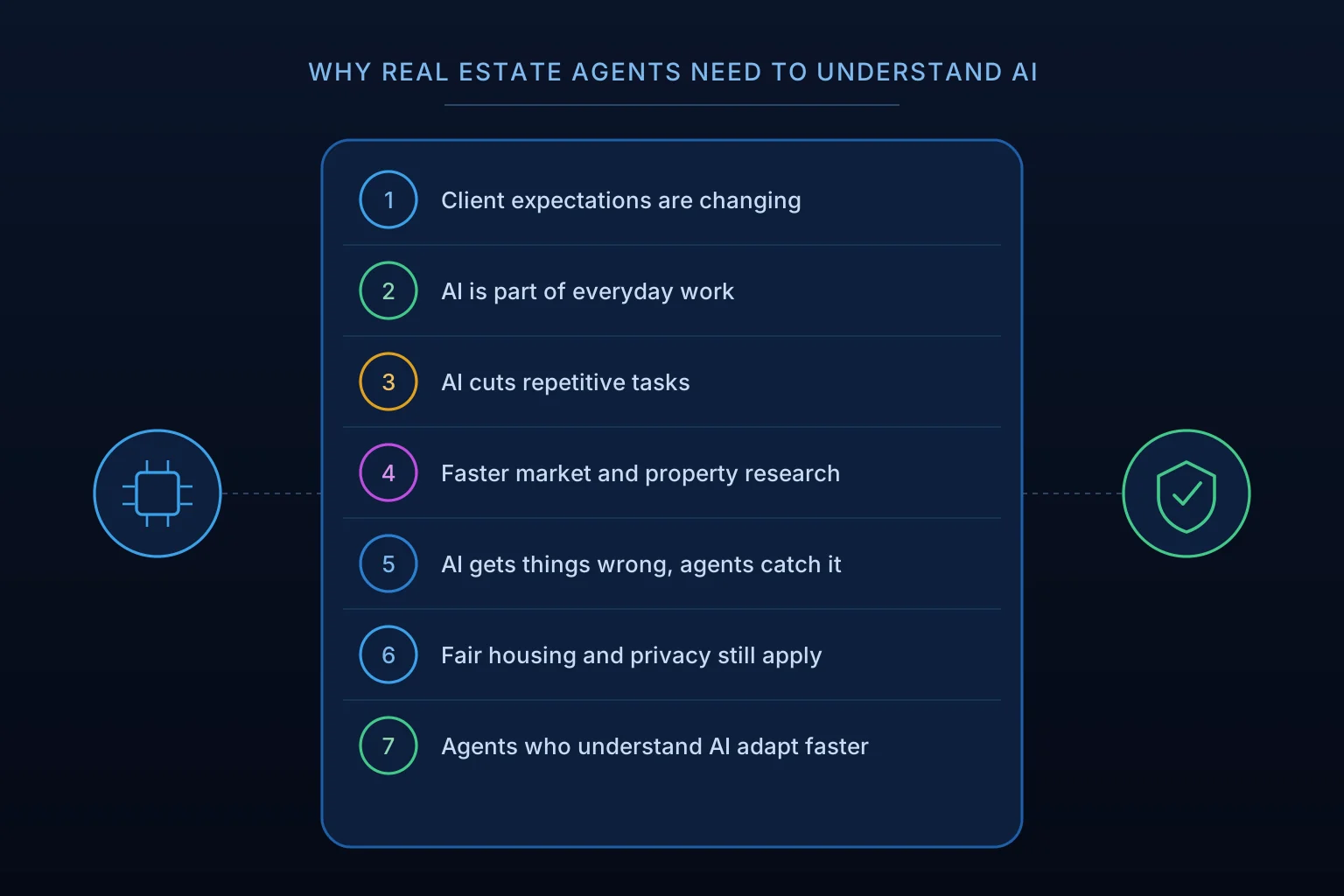
- Client Expectations Are Changing
- AI Is Already Part of Everyday Real Estate Work
- AI Cuts Repetitive Tasks
- AI Speeds Up Market and Property Research
- AI Gets Things Wrong, and Agents Need to Catch It
- Fair Housing and Privacy Rules Still Apply
- Agents Who Understand AI Adapt Faster
1. Client Expectations Are Changing
Buyers, sellers, and prospective renters can use AI tools to research neighborhoods, compare listings, explore rental rates, and prepare questions before contacting an agent. They may arrive with property comparisons, pricing assumptions, or recommendations generated by a chatbot.
For multifamily leasing agents, this means prospects may already have expectations about apartment availability, amenities, lease terms, or pricing based on information gathered online.
Agents who understand AI can help clients and prospects evaluate that information, correct inaccuracies, and provide important context that automated tools may overlook.
The value of an agent increasingly extends beyond providing information to helping people understand and act on it. Local expertise, property knowledge, and personal guidance remain essential, particularly when AI-generated answers are incomplete or outdated.
2. AI Is Already Part of Everyday Real Estate Work
AI is increasingly integrated into the tools residential and multifamily agents use every day, including:
- Listing descriptions, property marketing, and promotional content
- Lead management, prospect communication, and follow-up
- Showing and apartment tour scheduling
- Property research, market analysis, and rental comparisons
- Administrative work such as document summaries and transaction notes
- Leasing activity analysis and identification of potential conversion challenges
In multifamily housing, AI leasing assistants can respond to inquiries outside business hours, answer routine questions, schedule tours, and support consistent prospect follow-up.
Multi-Housing News highlights how AI is changing the role of apartment leasing professionals, including an example where approximately 60% of leasing interactions and leads occur outside regular business hours.
These technologies can improve responsiveness and reduce routine administrative work, allowing leasing teams to dedicate more attention to complex questions, prospect relationships, and converting qualified interest into signed leases.
For agents, understanding AI is increasingly about knowing how to work effectively alongside these tools rather than treating them as a separate technology.
3. AI Cuts Repetitive Tasks
AI can reduce time spent on routine activities such as drafting listing descriptions, preparing follow-up emails, summarizing documents, and answering common prospect questions.
For example, a residential agent might use AI to prepare an initial property description, while a multifamily leasing agent might use it to draft responses to frequently asked questions about apartment features, amenities, or the leasing process.
The agent still needs to verify property details, confirm accuracy, and adjust the communication to reflect the situation and audience.
Effective AI use also depends on knowing how to provide clear instructions. A specific request that includes the communication objective, relevant property information, intended audience, and preferred tone generally produces a more useful starting point than a vague prompt.
The goal is not to eliminate human involvement, but to reduce repetitive preparation so agents can spend more time on client relationships, showings, leasing activity, and decisions that require professional judgment.
Read Also:
4. AI Speeds Up Market and Property Research
AI can analyze large amounts of information quickly, helping agents research neighborhoods, compare properties, and summarize market trends. Residential agents can use it to review comparable sales and local market conditions, while multifamily leasing agents can explore rental trends, apartment features, and available unit types.
These tools help agents prepare for client conversations more efficiently, but AI-generated information should always be verified against current listings, approved property data, and reliable market sources before being shared.
5. AI Gets Things Wrong, and Agents Need to Catch It
AI tools can generate confident, convincing answers that are inaccurate, incomplete, or based on outdated information.
A residential agent might encounter an incorrect school boundary, an invented zoning detail, or an inaccurate property description. A multifamily leasing agent might receive an AI-generated response that misstates apartment availability, lease terms, included amenities, or current pricing.
These errors can create unrealistic expectations, undermine trust, or lead clients and prospects to make decisions using incorrect information.
Agents bring essential context that automated systems may lack. They understand individual properties, local market conditions, client priorities, and the operational details behind a transaction or lease.
For example, an AI assistant might describe an apartment as available based on outdated information, while the leasing team knows that the unit is already committed or has an updated availability date.
Understanding AI means recognizing when information requires verification, knowing which systems contain the authoritative data, and reviewing important details before communicating them to clients.
The professional advantage isn't simply knowing how to generate an answer. It's knowing how to evaluate whether that answer is accurate and appropriate.
6. Fair Housing and Privacy Rules Still Apply
Fair housing laws apply to marketing copy, property descriptions, and client communications, regardless of whether a person or AI generated them. AI tools can unintentionally produce discriminatory language, misleading information, or content that creates compliance risks.
Agents should ensure their AI tools are configured to follow fair housing and privacy guidelines, while independently reviewing outputs for accuracy and compliance. Confidential client information, financial details, and sensitive transaction data should also be protected when using AI platforms.
The National Association of Realtors emphasizes the importance of protecting confidential information and reviewing AI-generated content before sharing or publishing it.
7. Agents Who Understand AI Adapt Faster
AI tools will continue to evolve, and agents who understand how to evaluate them can adopt useful technologies while avoiding those that add unnecessary complexity.
According to the National Apartment Association, fully deployed AI adoption in surveyed multifamily leasing operations increased from 24% in 2025 to 34% in 2026. As automation takes on more routine tasks, agents can focus on prospect relationships, personalized service, and leasing decisions that require human expertise.
Beyond leasing, platforms like Rentana use AI to analyze pricing, occupancy, and leasing performance, helping multifamily operators make more informed decisions. Understanding these applications helps agents adapt as AI becomes more integrated into real estate operations.
Top Picks for you:
- 7 AI Adoption Challenges in Real Estate & How to Solve Them
- AI Adoption in Multifamily: Top Trends for Operators
How AI Is Transforming the Broader Real Estate Industry
Beyond everyday agent workflows, AI is also changing how real estate owners, investors, and operators evaluate property performance and make strategic decisions.
In multifamily housing, for example, leasing activity provides valuable information about demand, conversion, and property performance. When analyzed alongside occupancy, availability, renewals, and asset objectives, that information can help revenue managers and asset managers identify emerging risks and make more informed decisions.
Rentana is one example of AI being applied to multifamily revenue management and asset performance analytics. The platform connects property operating data with customer-configured objectives to support transparent pricing recommendations, occupancy forecasting, and proactive performance insights.
Through capabilities such as AI-Generated property insights and Ask Rentana, owners and operators can investigate changes in leasing performance, future availability, renewal trends, and other factors that influence revenue.
These applications demonstrate how the role of AI extends beyond automating communication. Real estate professionals across leasing, revenue management, and asset management increasingly benefit from understanding how AI analyzes information, identifies potential risks, and supports decisions.
As with agent-facing tools, the objective is to strengthen professional judgment through better information, not replace it.
Conclusion on Why Real Estate Agents Need to Understand AI
Understanding AI is becoming an increasingly important skill for real estate professionals, whether they work in residential sales, apartment leasing, or property operations.
AI can accelerate research, improve communication, reduce repetitive tasks, and provide valuable insights into property and market performance. However, its value depends on how accurately information is interpreted, how responsibly tools are used, and how effectively professionals apply their own expertise.
The goal is not to become an AI expert or automate every part of the job. It's to understand where technology adds value, recognize its limitations, and use it to deliver better service and make more informed decisions.
As AI continues to evolve, real estate agents who combine technological literacy with local knowledge, strong relationships, and professional judgment will be better equipped to adapt to the changing industry.