

Internet access has become as fundamental to apartment living as running water and heating. Yet despite that reality, the way multifamily properties deliver connectivity to residents has remained inconsistent, fragmented, and in many cases completely left to individual tenants to figure out on their own.
That's changing. A growing number of property owners and operators are moving toward managed WiFi, a building-wide internet infrastructure model where the owner controls the network and residents connect without needing to set up their own individual service accounts.
According to a 2024 survey by the National Multifamily Housing Council, reliable high-speed internet ranks among the top three amenities residents consider when choosing an apartment, ahead of fitness centers, pools, and package lockers.
The question for most property owners isn't whether to offer managed WiFi. It's who actually provides it, what the different models look like, and how to evaluate which approach makes the most sense for their specific property and resident base.
Related:
What Is Managed WiFi in Multifamily Buildings?
Managed WiFi in multifamily buildings is a building-wide internet infrastructure solution where a single network is deployed across the entire property and made available to all residents, typically included in rent or as an optional add-on amenity. Unlike traditional residential internet where each tenant independently contracts with an internet service provider, installs their own equipment, and manages their own connection, managed WiFi is owned, operated, and maintained at the property level rather than the unit level.
The infrastructure typically consists of commercial-grade access points installed throughout the building including hallways, common areas, and individual units, connected through a structured cabling system to a central network switch and a high-capacity internet connection that serves the entire property.
Residents connect to the network the same way they would connect to any WiFi network, without needing to schedule an installation, rent a modem, or manage a separate monthly bill.
The key distinction between managed WiFi and a simple bulk internet arrangement is the management layer. A bulk internet agreement gives the property a single large pipe of bandwidth that residents share, often without any quality controls, dedicated support, or per-unit performance guarantees.
A true managed WiFi solution includes active network management, monitoring, resident-facing support, and in most cases performance standards that the provider is contractually obligated to meet. That management layer is what separates a functional amenity from a frustrating one.
How Managed WiFi Works in a Multifamily Building
Here's how a typical managed WiFi deployment works from infrastructure to resident experience:
- Site survey and network design: The provider assesses the building's layout, construction materials, and unit count to determine the number and placement of access points needed for full coverage at target performance levels
- Infrastructure installation: Commercial-grade wireless access points are installed in each unit and throughout common areas, connected through structured cabling to a central network switch room where the building's main internet connection terminates
- Backhaul connection: The building connects to the internet through a high-capacity fiber or coaxial backhaul connection, sized to support simultaneous usage across all units at the provider's guaranteed bandwidth per unit
- Network management platform: The provider runs a cloud-based management platform that monitors network performance, identifies outages or congestion in real time, and allows remote troubleshooting without requiring a technician visit for most issues
- Resident onboarding: Residents connect through a simple onboarding portal, typically accessed through a browser or an app, where they create an account and accept the terms of service before gaining full network access
- Ongoing support: Most managed WiFi providers offer resident-facing support through a dedicated helpline, chat, or app, handling connectivity issues directly rather than routing residents through the property management office
- Billing and reporting: The property owner receives a single monthly invoice for the managed service, with usage reporting and performance data available through the provider's management portal
Read Also:
Who Provides Managed WiFi for Multifamily Buildings? Top Categories of Providers
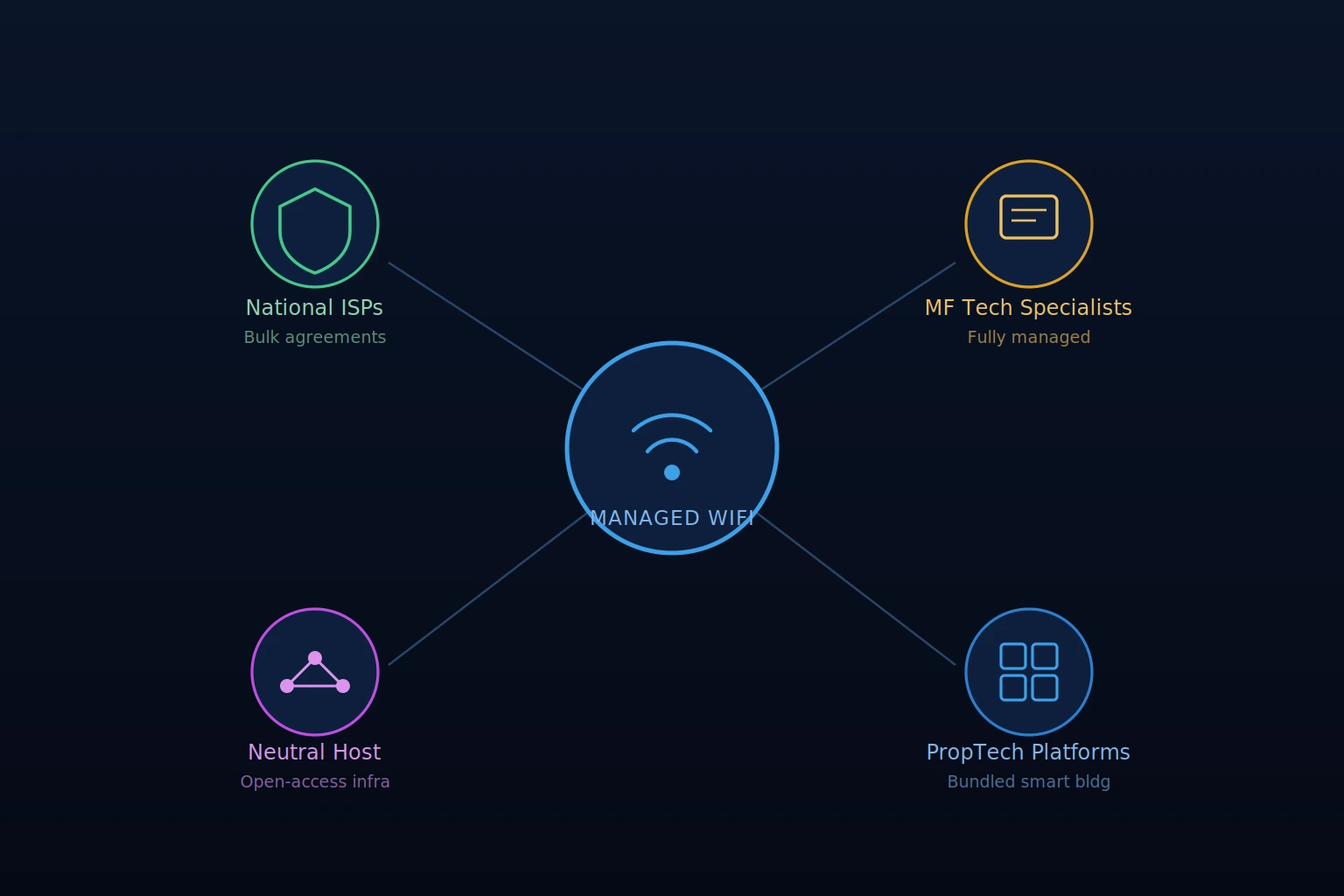
The managed WiFi provider landscape in multifamily real estate falls into several distinct categories, each with a different business model, deployment approach, and relationship with the property owner. Those categories include national internet service providers offering bulk agreements, multifamily technology specialists providing fully managed end-to-end solutions, neutral host network operators deploying open-access infrastructure, and property technology platform providers bundling WiFi into broader smart building systems.
Understanding which category applies to your property and what each one actually delivers is the starting point for making a decision that serves your residents and your NOI for the life of the contract.
1. National Internet Service Providers with Bulk Agreements
The largest cable and fiber internet providers offer bulk internet agreements for multifamily properties where the property owner contracts for a building-wide service that covers all units under a single commercial agreement. These arrangements give the property access to the provider's existing network infrastructure where it already passes the building, which simplifies deployment in markets where that infrastructure is already in place.
The limitation of national ISP bulk agreements is that they are primarily bandwidth delivery arrangements rather than fully managed WiFi solutions.
The ISP delivers internet to the building but the in-unit WiFi experience, the network management layer, and the resident support infrastructure are often minimal or require additional investment from the property owner. ISP bulk agreements also typically come with exclusivity provisions that prevent the property from offering competing services, which limits long-term flexibility.
2. Multifamily Technology Specialists
A distinct category of providers focuses exclusively on the multifamily market and offers purpose-built managed WiFi solutions designed specifically for the operational and commercial realities of apartment properties.
These providers deploy and own the in-building network infrastructure, manage it remotely, handle resident support directly, and structure their commercial arrangements around property-level contracts rather than individual resident subscriptions.
According to Maravedis Research, providers positioned to win in 2026 are those proving they can reduce friction for site teams, drive measurable revenue for owners, and deliver an experience that residents just love, differentiating less on speed and more on what sits around the network including AI-driven support, property management integrations, and financial tools like tech fee structures.
What distinguishes multifamily technology specialists from general ISPs is the depth of the managed service, including guaranteed bandwidth per unit, proactive network monitoring, and resident-facing support that doesn't route through the property management office.
3. Neutral Host Network Operators
Neutral host operators deploy and own the physical network infrastructure in a building and then allow multiple internet service providers to deliver service over that infrastructure. Rather than being tied to a single ISP's network, a neutral host model creates an open access environment where residents can choose from multiple competing service providers, all running over the same in-building physical infrastructure.
This model is more common in large mixed-use developments and high-rise residential towers than in standard multifamily communities, but it is gaining traction as property owners look for ways to avoid long-term exclusivity commitments with a single provider. The neutral host approach requires more upfront coordination and infrastructure investment but offers greater long-term flexibility and potentially stronger resident satisfaction by preserving consumer choice.
4. Property Technology Platform Providers
A growing number of property technology companies have added managed WiFi to broader smart building or resident experience platforms that also include smart access control, package management, utility billing, and resident engagement tools. In these cases, WiFi is one component of a larger connected building infrastructure rather than a standalone service.
For property owners already investing in smart building technology, bundling managed WiFi into a broader PropTech platform can simplify vendor management and create a more integrated resident experience.
Smart building operators are increasingly integrating HVAC, lighting, and surveillance over WiFi mesh to cut structured cabling costs by 40% and enable predictive maintenance analytics, which gives property owners additional operational efficiency beyond connectivity alone.
In practice, most multifamily properties that have deployed managed WiFi are working with either a national ISP bulk agreement supplemented by additional in-building equipment, or a dedicated multifamily technology specialist that handles the full stack from infrastructure to resident support. Increased demand for seamless connectivity and network performance optimization drives 60% of managed WiFi solution adoption, reflecting how far resident expectations around internet access have moved beyond basic connectivity toward a fully managed, always-on experience.
Top Picks:
- What Does BTR Stand for in Multifamily Housing?
- How to Buy a Multifamily Property with no Money (Financing Options)
What to Look for When Evaluating a Managed WiFi Provider
Not all managed WiFi providers are equal, and the wrong choice can create resident satisfaction problems, operational headaches, and contractual constraints that are difficult to exit. Here are the most important criteria to evaluate.
1. Network Performance Guarantees
Ask specifically what the provider guarantees in terms of bandwidth per unit, uptime percentage, and latency. A provider who can only speak to aggregate building bandwidth without committing to per-unit performance standards is effectively offering a best-effort service rather than a managed one. Look for contractually backed uptime guarantees of 99.9% or above and minimum bandwidth per unit that reflects realistic multi-device household usage, typically 25 Mbps or more per unit as a baseline in 2026.
2. Infrastructure Ownership and Contract Terms
Understand clearly who owns the physical infrastructure installed in the building. If the provider owns the equipment, what happens to it when the contract ends? Some providers install proprietary equipment that cannot be repurposed if you switch vendors, creating a de facto lock-in even after the contract expires. Look for reasonable contract lengths of three to five years with clear terms around equipment ownership, early termination, and what happens at renewal. Contracts exceeding seven years without meaningful performance-based exit provisions deserve scrutiny.
3. Resident Support Model
Clarify how resident support is handled. A managed WiFi provider whose support model routes resident connectivity issues through the property management office is creating an operational burden for your team rather than removing it. The best providers offer direct resident-facing support through a dedicated helpline, app, or chat platform, handling troubleshooting independently and only escalating to property management when the issue requires physical access to the building.
4. Revenue and Cost Structure
Understand whether the provider's model generates revenue for the property, recovers costs through bulk billing built into rent, or requires the property to absorb the full cost as an operating expense. Bulk billing models where the cost is included in rent are the most common structure, but revenue share arrangements where the provider bills residents directly and shares a portion with the property owner are also available and can turn managed WiFi from a cost line into an income line.
Don’t Miss:
- What Is a Multifamily Bridge Loan?
- What is Multifamily Underwriting? Complete Guide
- What is Multifamily Zoning?
Conclusion
Managed WiFi has moved from a luxury amenity to a baseline resident expectation in most multifamily markets, and the provider landscape has matured significantly to serve that demand. The right provider for any given property depends on building size, resident profile, existing infrastructure, and how the owner wants to structure the commercial arrangement.
The most important things to get right are the performance guarantees, the support model, and the contract terms. A managed WiFi solution that works reliably and handles resident issues without involving the property management team is a genuine operational asset. One that underdelivers on performance or creates lock-in that limits future flexibility is an expensive problem that can take years to unwind.
Treat the provider selection process with the same rigor you would apply to any significant capital or operational decision, because the infrastructure you install today will define the resident connectivity experience at your property for the life of the contract.
Frequently Asked Questions on Who Provides Managed WiFi for Multifamily Buildings?
Who Provides Managed WiFi for Multifamily Buildings in Miami?
Miami's multifamily market is served by a combination of national cable and fiber ISPs offering bulk agreements and multifamily technology specialists providing fully managed solutions. Given Miami's high-density condo and apartment stock, properties with 50 or more units have the strongest negotiating position for bulk arrangements. Hurricane preparedness and infrastructure redundancy are Miami-specific considerations worth raising with any provider during contract negotiations.
Who Provides Managed WiFi for Multifamily Buildings in Atlanta?
Atlanta's rapidly expanding multifamily market attracts both national ISPs with existing fiber infrastructure and dedicated multifamily WiFi specialists. The city's strong population growth and active development pipeline mean most newer properties are being built with managed WiFi infrastructure already planned into the development budget rather than retrofitted after completion.
Who Provides Managed WiFi for Multifamily Buildings in Houston?
Houston's large and geographically spread multifamily market is served by multiple fiber and cable ISPs through bulk agreements as well as national multifamily technology specialists. Given Houston's size and diversity of building types, the right provider depends heavily on whether the property is in a dense urban corridor with existing fiber infrastructure or a suburban location where coverage options may be more limited.
Who Provides Managed WiFi for Multifamily Buildings in Chicago?
Chicago's dense urban multifamily market benefits from strong existing fiber and cable infrastructure across the metro, giving property owners competitive options among both national ISPs and fully managed WiFi specialists. High-rise buildings in particular tend to require purpose-built in-building network infrastructure rather than standard residential ISP products to achieve reliable per-unit performance.
Who Provides Managed WiFi for Multifamily Buildings in Denver?
Denver's tech-forward renter base and active multifamily development market have driven strong adoption of managed WiFi as a standard amenity rather than a premium one. Property owners have access to both national ISP bulk agreements and multifamily technology specialists offering fully managed solutions with resident support, with the best option depending on building age, size, and existing infrastructure.


