Studio
Units
10
Monthly Rent
$1,200
Annual GPR
$144,000



When you're underwriting a multifamily property, every number in your model flows from one starting point: gross potential rent. Get it right and the rest of your analysis has a solid foundation to build on. Get it wrong and every metric that follows, NOI, cap rate, cash-on-cash return, equity multiple, is distorted from the very first line.
Most investors understand GPR in concept but make critical errors when they actually sit down to calculate it. They use asking rents instead of leased rents, ignore the unit mix, or conflate GPR with what the property is actually collecting today. Those errors compound through the entire model and produce projections that look clean on paper but fall apart the moment they make contact with reality.
This article covers exactly what gross potential rent is, how to calculate it correctly, how it relates to other key revenue metrics, and how to use it to identify the real upside in a multifamily deal.
Gross potential rent is the maximum rental income a property could generate if every unit were occupied at full market rent for an entire year with no vacancies, no concessions, and no unpaid rent. It represents the theoretical income ceiling of the property, the best-case scenario before any real-world adjustments are applied.
The keyword here is potential. GPR is not what the property is currently collecting. It is not what was collected last year. It is what it could collect under perfect conditions. That distinction matters enormously in underwriting because confusing gross potential rent with actual collected income is one of the fastest ways to build a financial model that overstates a property's revenue from the very first line.
In multifamily underwriting, GPR is always the starting point of the revenue model. Every other income metric flows down from it. Vacancy loss is deducted from GPR. Concessions are deducted from GPR. Credit loss is deducted from GPR. What remains after those deductions is effective gross income, or EGI, which is the revenue the property can realistically be expected to collect. GPR without those deductions is useful for understanding upside. EGI is what you actually underwrite.
GPR also serves as a benchmark for measuring how efficiently a property is being operated. If a 50-unit building has a GPR of $900,000 but is only collecting $720,000, that $180,000 gap tells you something important about vacancy levels, below-market leases, concessions, or some combination of all three. Understanding why that gap exists, and whether it can be closed, is often the core of a value-add business plan.
Related:
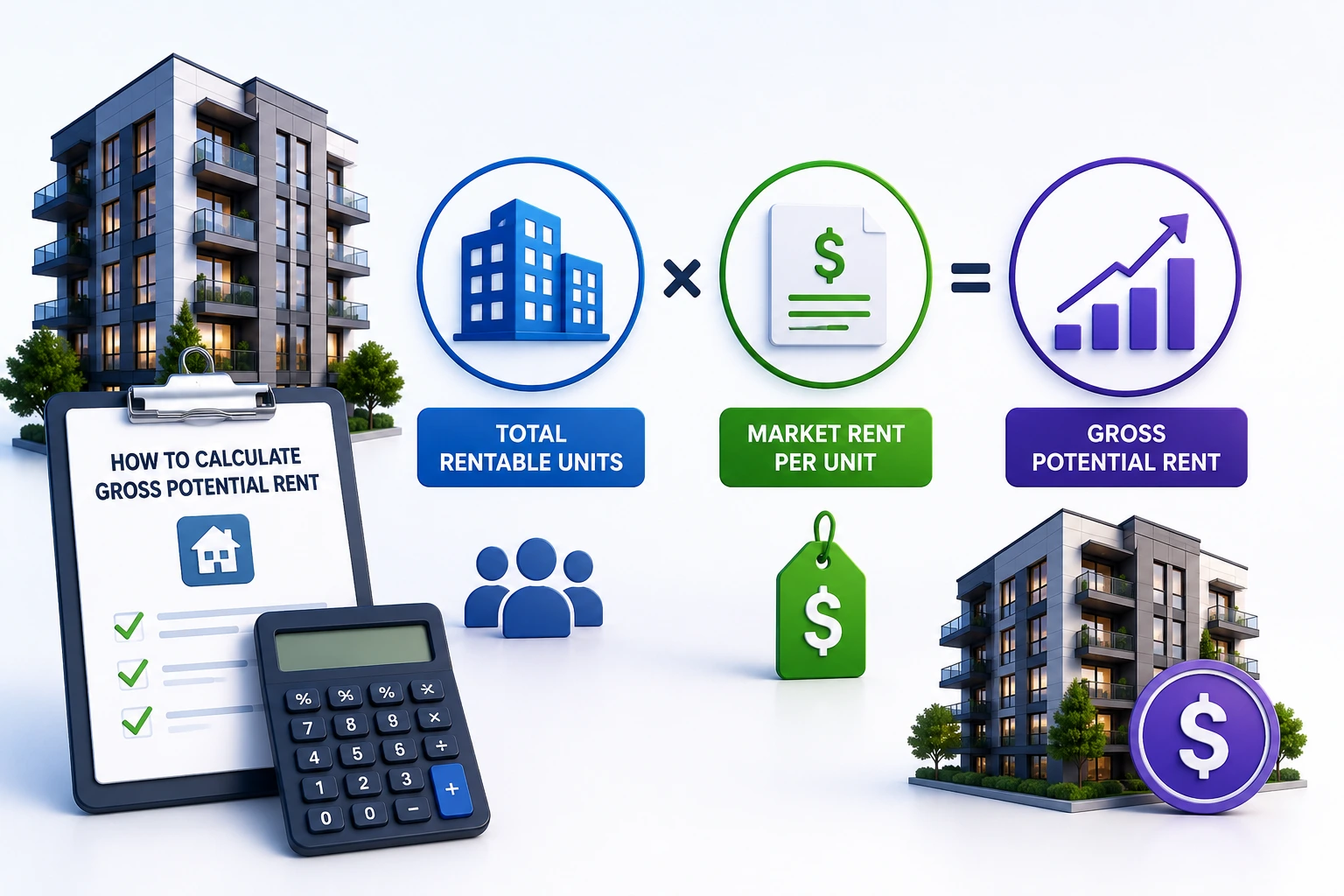
The GPR formula is straightforward:
GPR = Number of Units × Monthly Market Rent × 12
For properties with multiple unit types, calculate GPR separately for each unit type and add them together.
This property's gross potential rent is $1,062,000 annually. That's the income ceiling before vacancy, concessions, and credit loss are applied.
This is where most underwriting errors start. GPR should always be calculated using market rent, meaning what comparable units in the submarket are actually leasing for today, not what current tenants are paying. If a property has below-market leases, the in-place rent will understate GPR and mask the true income potential of the asset.
For example, if current tenants in the 2-bedroom units above are paying $1,800 instead of the $2,100 market rent, the in-place GPR on those units is $324,000 rather than $378,000. That $54,000 annual gap is the rent upside embedded in the property, and it's exactly what a value-add investor is underwriting to capture.
Gross potential rent and effective gross income are both revenue metrics, but they measure very different things and serve different purposes in a multifamily underwriting model.
Gross potential rent is the theoretical maximum income a property could generate if every unit were occupied at full market rent for the entire year. It assumes zero vacancy, zero concessions, and zero unpaid rent. It is not a realistic projection of what the property will collect. It is a benchmark that represents the income ceiling of the asset under perfect conditions.
Effective gross income is what the property can realistically be expected to collect after real-world adjustments are applied to GPR. It deducts vacancy loss, concessions, and credit loss from GPR, then adds back any non-rental income like parking fees, laundry, and pet fees. EGI is the number you actually underwrite because it reflects achievable revenue rather than theoretical maximum revenue.
The simplest way to think about the relationship between the two: GPR is where your revenue model starts, and EGI is where it lands after accounting for the realities of operating a rental property. Here's what that looks like in practice:
The gap between GPR and EGI in this example is roughly $55,000, which represents the combined drag of vacancy, concessions, and bad debt on the property's achievable revenue. Tracking that gap and understanding what's driving it is one of the most important parts of evaluating a multifamily property's operational health.
Related:
Gross potential rent is more than just a starting line in a revenue model. When used correctly it's one of the most powerful tools for identifying value-add opportunities and understanding how much upside is actually embedded in a multifamily deal.
The difference between a property's current in-place GPR and its market GPR is called the rent gap, and it's the number that drives most value-add acquisition theses. When a property has tenants paying below-market rents, the in-place GPR understates what the property could collect if those leases were renewed or turned over at market rates.
For example, a 40-unit property where tenants are paying an average of $1,400 per month has an in-place GPR of $672,000 annually. If market rents for comparable units are $1,750, the market GPR is $840,000. That $168,000 annual gap is the rent upside the investor is underwriting to capture through renovations, lease renewals, and turnover.
That gap also directly affects what the property is worth. At a 5.5% cap rate, closing that $168,000 rent gap, assuming expenses stay flat, adds roughly $3 million in value to the asset. That's the math behind most value-add business plans and why GPR analysis is so central to acquisition underwriting.
When evaluating whether a purchase price makes sense, comparing the seller's in-place GPR to the property's market GPR tells you immediately how much of the upside is already priced in and how much remains to be captured.
A seller pricing a property based on market GPR is essentially asking you to pay for upside you haven't yet realized. A property priced on in-place GPR with a clear path to market rents is where the real opportunity tends to live. Understanding which situation you're in before you make an offer is one of the most important judgment calls in multifamily underwriting.
Read Also:
Getting GPR wrong doesn't just affect one line in your model. Because every other revenue metric flows from it, errors in GPR compound through the entire underwriting analysis. Here are the mistakes that show up most often.
This is the most common and most consequential GPR mistake. Asking rents, the prices landlords advertise on listing platforms, are almost always higher than what tenants are actually signing leases at. In competitive markets or periods of softening demand, the gap between asking rents and effective leased rents can be 5% to 10% or more once concessions are factored in.
Always anchor GPR to actual executed leases on comparable units in the submarket. If you can't access lease-level data, apply a concession discount to asking rents before using them in your model. Building GPR on asking rents that the market isn't clearing guarantees an overstated revenue projection from line one.
Calculating GPR using a single average rent across all units rather than running the calculation separately for each unit type is a shortcut that produces inaccurate results on any property with a mixed unit configuration. A building with studios, one-bedrooms, and two-bedrooms has very different market rents for each unit type, and averaging them together masks that variation.
Always build GPR from the unit level up, multiplying the market rent for each unit type by the number of units in that category and summing the results. The worked example in section one shows exactly how to do this cleanly.
GPR is a theoretical maximum, not a reflection of what the property is currently collecting. Using the current rent roll total as a proxy for GPR understates the property's income potential if rents are below market, and overstates it if concessions or unpaid rent are inflating the reported figures.
These are two completely different numbers that answer two completely different questions. GPR tells you what the property could collect at full occupancy and market rents. The rent roll tells you what it is collecting today. Both are useful, but only when you know which one you're looking at.
In a value-add underwriting model that projects performance over a three to five year hold period, GPR needs to be updated each year to reflect projected rent growth. Holding GPR flat across the entire hold period while projecting NOI improvement is an internal inconsistency that produces unreliable return projections.
Model rent growth as an annual percentage increase applied to the market rent assumptions in each year of the hold period, and recalculate GPR from the unit level up each time. Even modest rent growth assumptions of 2% to 3% annually compound meaningfully over a five year hold and have a significant impact on projected exit value.
Don’t Miss:
Gross potential rent and gross scheduled rent are closely related but not identical. GPR represents the maximum income a property could generate if every unit were occupied at full market rent. Gross scheduled rent, on the other hand, uses the actual contracted rents in current leases rather than market rents. On a property with below-market leases, gross scheduled rent will be lower than GPR because it reflects what tenants are actually paying today rather than what the market would support.
Not exactly. Effective gross income and effective gross revenue are terms that are often used interchangeably, but there is a subtle distinction. EGI is the more commonly used term in multifamily underwriting and typically refers to GPR minus vacancy loss, concessions, and credit loss, plus other income. EGR is less standardized and may be used differently depending on the context or the organization using it.
Gross potential rental income is the theoretical maximum a property could collect at full occupancy and market rents with no deductions. Gross rental income is the actual income the property collects from rent payments in a given period, reflecting real occupancy levels, in-place lease rates, and any unpaid rent. The gap between the two reveals how far the property is from its income ceiling and is one of the clearest indicators of operational efficiency and value-add opportunity.


