Most multifamily operators are not struggling because they lack data. They are struggling because the data they have lives in too many places, arrives too late, and requires too much manual interpretation before it can inform a decision that still has time to matter.
Most multifamily performance challenges do not begin in the financials. They begin operationally. A new lease-up changes market conditions. Leasing velocity slows. Unexpected notices increase future exposure. Renewal conversion softens. The risk is not that these signals do not exist. The risk is that they are identified too late, after the effects have already begun working their way through occupancy, revenue, and ultimately NOI.
According to Propmodo, multifamily analysts spend 80% to 90% of their time collating data and only 10% to 20% of their time actually analyzing it, because pricing, leasing, budgeting, and maintenance systems remain effectively fragmented, curtailing impactful decision-making.
In that environment, the difference between operators who see performance shifts coming and those who explain them after the fact is increasingly a function of whether the tools they are working with connect those systems or leave teams to do it manually.
Rentana was built specifically to close that gap. Not as another reporting layer, but as a revenue intelligence platform that connects pricing, leasing, renewals, exposure, occupancy, and portfolio performance into a single operational view, so the people responsible for performance are working from what is happening and where it is heading rather than what already occurred.
Related:
- The Best Revenue Management For Multifamily Housing
- The Best Multifamily Pricing Tool for Investors
The Visibility Gap in Multifamily Operations
Multifamily teams are not struggling because they lack data. Most have more reports, dashboards, and operating metrics than ever before. The challenge is understanding which signals matter, how conditions are changing across the portfolio, and where attention should be focused before performance issues become visible in the financials.
Most performance shifts begin operationally. Leasing velocity softens. Unexpected notices increase future exposure. Renewal conversion trends weaken. A new lease-up enters the submarket. Individually, these changes may seem small. Together, they can materially influence occupancy, revenue, and NOI long before those impacts appear in monthly reporting.
The challenge is not collecting this information. It is identifying which changes matter, understanding how they connect, and evaluating them quickly enough to respond while options remain available.
Rentana helps multifamily teams evaluate portfolio performance through a more connected, forward-looking lens by bringing together the operational signals that influence revenue, occupancy, and asset performance.
How Rentana Approaches Revenue Management Differently
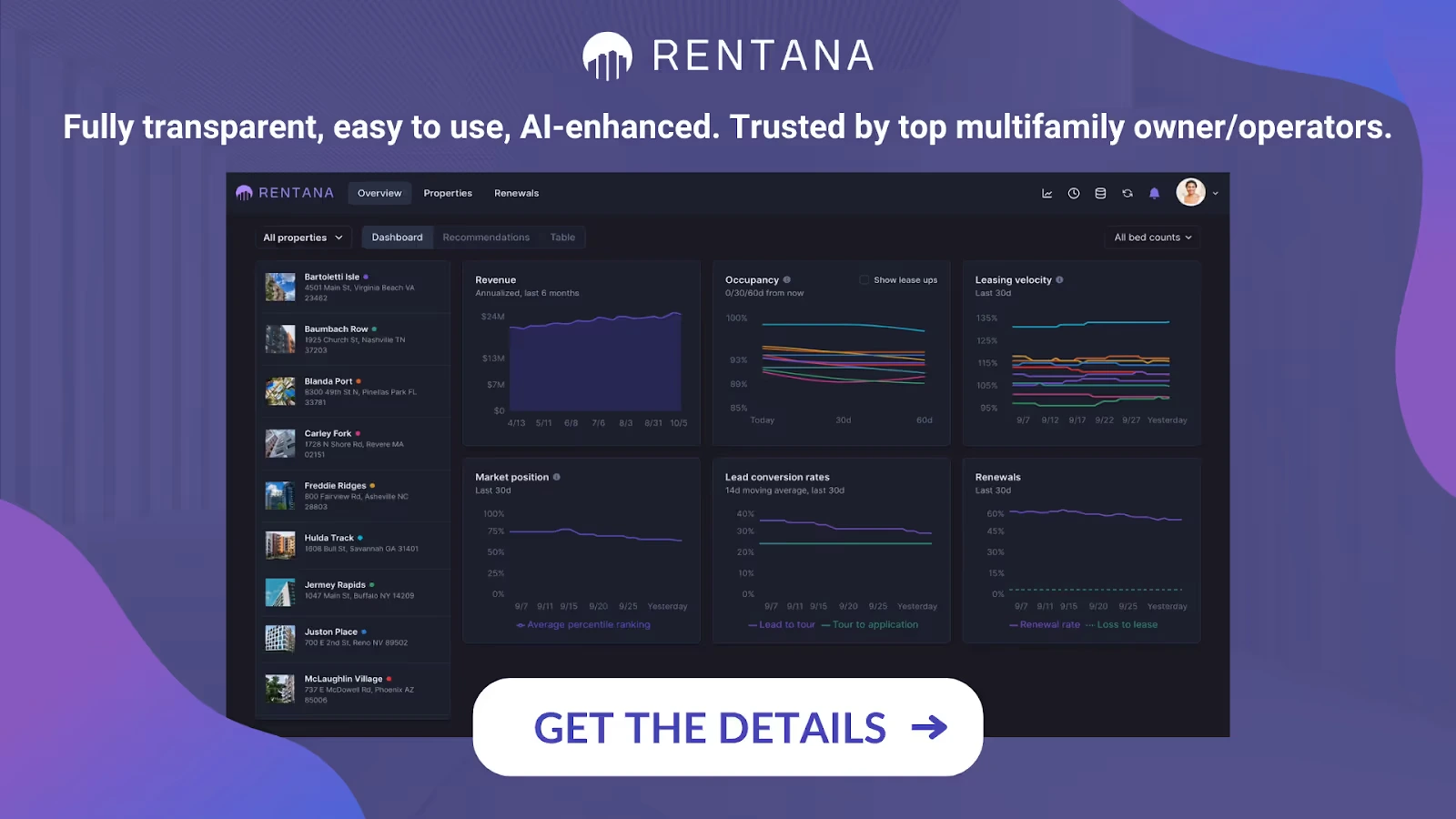
Rentana is an AI-powered revenue intelligence platform built specifically for multifamily operators. Where traditional revenue management tools focused primarily on pricing, Rentana connects pricing to the full set of operational signals that determine whether a portfolio is actually performing, leasing velocity, renewal conversion, exposure concentration, predicted occupancy, and portfolio-level visibility, all in a single view.
The distinction matters because pricing is only one part of revenue management. A pricing decision made without visibility into current leasing velocity is a pricing decision made on incomplete information. Renewal decisions become more effective when evaluated alongside forward exposure and availability conditions rather than in isolation. Rentana is built around the idea that these decisions should not be managed separately, and that the gap between them is where performance problems quietly build.
1. Portfolio Visibility and Prioritization
Rentana gives operators a connected view of portfolio performance, helping teams quickly identify which assets are performing as expected, which may be beginning to drift, and where additional attention may be warranted. Portfolio dashboards provide a color-coded view of asset health while allowing users to move seamlessly from portfolio-level trends into property-level detail.
AI-generated property insights help surface changing conditions at the asset level by summarizing what is happening, why it matters operationally, and the factors contributing to the shift. Rather than requiring teams to review dozens of reports and metrics individually, insights help focus attention on the performance changes most likely to influence occupancy, revenue, and asset performance.
A comprehensive reporting library provides deeper operational visibility when additional analysis is needed, helping teams evaluate leasing activity, renewals, occupancy, pricing, and portfolio performance from multiple perspectives.
2. Explainability and Transparency
Rentana's revenue management approach is built around transparency rather than black-box recommendations. Pricing recommendations are generated at the bedroom type or custom unit-group level and include the supporting context behind each recommendation. Teams can review the operational conditions contributing to the recommendation, evaluate the reasoning, and apply their own judgment before making a decision.
This transparency helps revenue managers understand not only what recommendation is being presented, but why it is being presented. Rather than replacing human decision-making, Rentana is designed to support it by making the underlying factors visible and easier to evaluate.
Read Also:
- Leasing Solutions for Managing Multiple Multifamily Assets
- 7 Key Multifamily Revenue Optimization Strategies
3. Forward-Looking Performance Signals
Rentana helps teams evaluate performance through a forward-looking lens rather than relying solely on historical reporting. Predicted occupancy connects current leasing activity, renewal trends, and future availability to provide forward visibility into where occupancy is heading. Exposure forecasting helps identify where future availability and lease expiration concentration may create operational pressure before those conditions are reflected in occupancy results.
Leasing velocity and renewal conversion visibility provide additional context around how current operating conditions may influence future performance. Rather than evaluating occupancy, renewals, and leasing activity as separate metrics, teams can understand how those signals are interacting and where performance may be beginning to shift.
The result is earlier visibility into changing conditions and more time to evaluate potential responses before those changes become fully visible in financial reporting.
4. Faster Decision Cycles
One of the biggest challenges in multifamily operations is not identifying performance shifts. It is reducing the time between identifying a change and evaluating an appropriate response. When data lives across multiple systems, teams often spend more time assembling information than discussing what it means.
Rentana is designed to shorten that cycle. On-demand synchronization allows teams to refresh recommendations and operational data when conditions change rather than waiting for scheduled update windows. Shared visibility across revenue management, asset management, leasing, and operations helps ensure everyone is working from the same current information rather than different versions of the same story.
The result is a faster path from visibility to evaluation, allowing teams to spend less time gathering information and more time making informed decisions.
What Rentana Produces in Practice: Three Case Studies
The outcomes Rentana delivers are not theoretical. Here is what three different operators experienced after deploying the platform.
URS Capital Partners: 8.2% NOI Growth in One Quarter
URS Capital Partners deployed Rentana across 12 properties totaling 2,500 units in just two weeks, marking their first foray into revenue management technology. The results over the following year were concrete:
- 8.2% sequential NOI growth from Q1 to Q2
- 7.3% daily occupancy improvement from March to September 2025
- 414% ROI over the course of the year
- Pricing analysis time cut from 90 minutes to 15 minutes per property, saving more than four hours per week
"Rentana is the best tool to manage your business and focus on what matters," said Heather Moore, Consultant at URS Capital Partners. "It's beyond BI. It's an interactive dashboard where operators and asset managers can see not just if they can make more money, but exactly how to make more money."
What drove the result was not just the technology. It was the combination of transparent pricing recommendations, real-time public market signals, and a platform the team could adopt without disrupting existing workflows. URS credited Rentana's guided onboarding and intuitive dashboards for enabling a fast, frictionless deployment that got the team to an insight-driven, NOI-first approach immediately.
Orion Real Estate Partners: 350% ROI in Five Months
Before adopting Rentana, Orion Real Estate Partners was working through a manual, time-consuming pricing process that was seeing rent decline by 3.5%. Digging through multiple systems and reports to assess pricing was inefficient and proving unsuccessful. After evaluating the revenue management landscape, Orion chose Rentana for its real-time, personalized insights delivered through an intuitive, privacy-first platform. Within five months:
- 350% return on investment
- Pricing reviews cut from one hour to 10 minutes per property per day, a 6x improvement
- Occupancy increased by 2%, enabling greater pricing power
- Teams were able to anticipate market shifts and set pricing proactively rather than reactively
"With Rentana, we've elevated our decision-making to a new level," said Mark Limpert, Principal at Orion Real Estate Partners. "The platform delivers intelligence and efficiency that allows us to stay ahead of market shifts and focus on driving results across our portfolio."
The Orion outcome illustrates a specific point about Rentana's revenue management approach. The problem was not a lack of data. It was a fragmented process that made the data too slow and too manual to act on before conditions had already moved. Rentana replaced that process with a connected, real-time view that the team could act on immediately.
29th Street Capital: $4.6M in Incremental Property Value in 90 Days
29th Street Capital manages a portfolio of more than 12,000 units. After a two-month review of eight software vendors and a 90-day head-to-head pilot against a competing platform from an established industry veteran, they selected Rentana. The results from the pilot were concrete:
- $4.6 million in incremental property value, 1.5x versus the competing platform
- 3.5% stronger net rental income growth compared to the control group
- 21x faster onboarding, with new properties going live in one to two days versus three to six weeks with legacy systems
- 36x faster support, with five-minute average response times versus three-day ticket delays
- 125 new features shipped during the 90-day pilot period
"I would recommend Rentana without a doubt," said Robert Waz, VP at 29th Street Capital. "The UI is miles ahead, we trust their data security, and their fast, insightful and personalized platform gives us a strategic advantage to grow our assets."
The 29SC outcome points to something specific about what Rentana's revenue management model delivers at institutional scale. The performance gap between Rentana-powered properties and the control group did not come from doing more work. It came from making better calls, faster, with clearer information, which is the return case for connected revenue intelligence in plain terms.
Top Picks:
- Top Uses of AI in Multifamily
- AI Adoption in Multifamily: Why it's Accelerating So Fast
Who Rentana Is Built For
Rentana's revenue management capabilities are designed around three specific roles, each with different needs from the same platform.
- Revenue managers need visibility into unit-level and portfolio-level performance drivers, pricing recommendations with full reasoning, and leasing velocity and funnel conversion signals that distinguish between a volume problem and a conversion problem
- Asset managers need portfolio-wide operational visibility and prioritization, forward-looking signals that surface drift before it reaches the financials, and shared visibility that keeps every team working from the same current picture
- Ownership groups and portfolio leadership need consistent performance oversight across assets without increasing operational complexity, and confidence that the decisions being made at the property level are informed by current conditions rather than stale reports
Conclusion on Rentana Revenue Management
Rentana was built for a specific problem. Not a lack of data, but a lack of visibility into what the data means, how conditions are changing, and where attention should be focused before performance has already shifted.
The three case studies in this article point to the same underlying outcome across different operator types and portfolio sizes. Better decisions, made faster, with clearer information. That is what connected revenue management actually looks like in practice, and it is what separates operators who are managing performance from those who are reporting it after the fact.
Revenue management is no longer just a pricing exercise. It is the coordination of pricing, leasing activity, renewals, exposure, and occupancy into a single performance strategy.
Frequently Asked Questions on Rentana Revenue Management
How Does Rentana Work?
Rentana integrates with your PMS to pull leasing, occupancy, and performance data automatically. It connects pricing, leasing velocity, renewal conversion, exposure forecasting, and predicted occupancy into a single view. AI-generated insights surface what is changing, why it matters, and what to do about it. Teams review recommendations with full reasoning attached and apply changes back to the PMS in one click.
How Does Rentana’s Revenue Management Work?
Rentana generates pricing recommendations at the bedroom type or custom unit-group level based on the asset strategy configured by the customer, including occupancy goals and target timeframes. Recommendations are informed by leasing performance, future availability, and public market conditions while remaining aligned with the property's objectives.
Supporting context is provided with every recommendation, allowing teams to evaluate pricing decisions within the broader context of asset and portfolio performance.
Is Rentana A Rent Optimization Software?
Rentana is a revenue intelligence platform that goes beyond rent optimization. It surfaces pricing recommendations with full transparency, showing the specific signals behind each one so teams can evaluate, adjust, and act with confidence. Recommendations are connected to leasing velocity, forward availability, and occupancy targets rather than market comps alone.
Can I Use Rentana As A Rental Pricing Software?
Yes. Rentana delivers pricing recommendations at the bedroom type or custom unit-group level based on the asset strategy configured by the customer, including occupancy goals and target timeframes. Recommendations are informed by leasing performance, future availability, and broader market conditions, with supporting context provided so teams can evaluate the reasoning behind each recommendation.
Is Rentana A Lease Renewal Optimization Software?
Rentana supports renewal management by helping teams evaluate renewal performance in the context of broader portfolio conditions. Configurable renewal generation settings allow operators to align offers with customer-defined asset strategy while maintaining visibility into conversion trends, retention performance, and forward availability conditions. This gives teams the ability to apply a consistent portfolio approach while retaining the flexibility to accommodate the unique goals of individual assets.