Pricing decisions in multifamily are rarely made in isolation, but they are often treated that way.
A rent change at one property affects leasing momentum. A renewal decision influences future availability. A cluster of expirations in one month can reshape exposure across an entire portfolio. Yet many pricing workflows still rely on periodic reviews that separate these signals instead of connecting them.
That gap is where most pricing inefficiencies come from.
Today, the operators with the strongest performance are not simply reviewing rents. They are reading the portfolio. They are tracking how quickly units lease, how availability is building, how renewal behavior is shifting, and how those signals interact across properties.
This is where analytics changes the role of pricing.
Instead of asking “What should rent be?” the better question becomes:
What are the signals telling us about demand, timing, and exposure right now?
When those signals are brought together, pricing becomes more than a number. It becomes a tool to guide leasing activity, shape future availability, and maintain consistency across the portfolio.
Related: The Best Rental Pricing Software for Multifamily
Why Rental Pricing Has Become More Complex in Multifamily
Rental pricing in multifamily now sits at the center of several moving parts that are constantly influencing each other.
Leasing velocity determines how quickly units are absorbed. Renewal activity shapes how many units return to the market. Lease expiration patterns influence future exposure. At the same time, new supply and shifting public market conditions continue to change demand across submarkets.
None of these factors operate independently.
A slowdown in leasing velocity can signal that pricing is out of step with demand. A drop in renewal conversions can increase future availability. A cluster of expirations can create pressure in specific months that pricing alone cannot immediately solve. Each of these signals feeds into the next, making pricing decisions more interconnected than they were in the past.
The pace of change has also accelerated.
Demand patterns can shift quickly based on seasonality, supply deliveries, or changes in renter behavior. What worked a few weeks ago may no longer reflect current conditions. This makes periodic pricing reviews less effective, as they often lag behind what is happening in real time across the portfolio.
Perhaps most importantly, pricing decisions today influence what happens next.
When rents are set, they affect leasing speed. Leasing speed affects how quickly availability is absorbed. Renewal decisions determine how much supply returns to the market. Together, these factors shape future occupancy and exposure across the portfolio.
This is why pricing is no longer just about setting rents for available units.
It is about understanding how pricing decisions influence demand, availability, and exposure over time, and how those dynamics interact across multiple properties simultaneously.
How Analytics Improves Rental Pricing Decisions
Analytics changes pricing from a scheduled task into an ongoing process.
Instead of reviewing rents at set intervals, operators can continuously evaluate how units are performing and how conditions are evolving across the portfolio. Leasing activity, availability, and renewal behavior are no longer reviewed after the fact. They are monitored as they develop.
This shift allows pricing decisions to stay aligned with current conditions rather than lag behind them.
At a high level, analytics improves pricing decisions by:
- Moving pricing from periodic to continuous decision-making
- Connecting operational data directly to pricing strategy
- Helping operators identify patterns earlier and act before performance shifts
Another key advantage of analytics is that it connects operational data directly to pricing strategy. Leasing velocity, predicted availability, renewal activity, and exposure patterns are not treated as separate reports. They become inputs that inform how pricing should move.
For example, slower leasing on a specific floorplan may indicate that pricing needs to be adjusted. An increase in upcoming availability may require a different approach to lease terms or renewal strategy. When these signals are viewed together, pricing decisions become more informed and more consistent across properties.
Analytics also helps operators identify patterns earlier.
Rather than waiting for changes to appear in occupancy or revenue reports, asset managers can detect shifts in leasing momentum, demand patterns, or exposure risk as they begin to emerge. This earlier visibility allows teams to respond before performance is affected at a broader level.
Rentana supports this approach by bringing these signals into a single system. Operators can monitor leasing velocity, evaluate predicted availability, and review pricing recommendations that reflect current demand conditions and public market data. AI-generated insights highlight when performance begins to shift and identify the key drivers behind those changes, helping teams determine whether pricing is the appropriate lever.
By making pricing continuous, connected, and forward-looking, analytics allows operators to move from reactive adjustments to more deliberate, data-informed decisions.
Related:
- How Real Estate Uses Data Analytics for Portfolio-Level Investing
- Business Analytics in Real Estate: Trends & Tools
Optimizing Rental Pricing with Analytics: The Key Signals
Effective pricing decisions are driven by a combination of operational and market signals rather than a single data point. Each signal provides context on how units are performing, how availability is evolving, and how demand is shifting across the portfolio.
When these signals are evaluated together, pricing becomes more precise and aligned with actual leasing conditions.
1. Leasing Velocity
Leasing velocity reflects how quickly units are moving through the leasing pipeline. It is one of the clearest indicators of demand at both the property and floorplan level.
When units lease quickly, it suggests strong demand at current pricing levels. When leasing slows, it may indicate that pricing is no longer aligned with demand or that conditions have shifted in the market.
Monitoring leasing velocity allows operators to adjust pricing in response to real leasing activity rather than relying solely on external benchmarks.
Rentana tracks leasing velocity across properties and unit types, helping operators identify where momentum is accelerating or slowing and evaluate how pricing decisions may be influencing those trends.
2. Predicted Availability
Predicted availability looks ahead at how many units are expected to become available over time based on current leases, renewal activity, and move-out patterns.
This signal is critical because pricing decisions today influence how future availability is absorbed. If a large number of units are expected to come online in a short period, pricing and leasing strategies may need to adjust in advance.
Without visibility into predicted availability, operators risk reacting to supply after it appears rather than preparing for it.
Rentana provides predicted occupancy and availability insights that allow asset managers to understand how supply is likely to develop across upcoming months.
Related: Real Estate Predictive Analytics Software for Multifamily
3. Renewal Activity
Renewal activity determines how many existing leases will extend and how many units will return to the market. It plays a direct role in shaping future availability and leasing pressure.
If renewal conversions are strong, fewer units re-enter the leasing pipeline. If renewal activity softens, availability can increase quickly, requiring adjustments in pricing and leasing strategy.
Evaluating renewal activity alongside new lease pricing helps ensure that retention decisions remain aligned with broader portfolio conditions.
Rentana allows operators to configure renewal strategy in alignment with asset-level pricing strategy, including how renewal offers relate to market rent and occupancy targets, and monitor how renewal behavior is affecting future availability.
4. Lease Expiration Exposure
Lease expiration exposure refers to how lease end dates are distributed across the calendar. When too many leases expire within the same period, properties can experience spikes in availability that create leasing pressure.
These exposure patterns often develop gradually and may not be visible in traditional reports until they begin to affect occupancy.
By analyzing lease expiration schedules in advance, operators can identify potential exposure risks and adjust pricing or lease term strategies to smooth availability across months.
Rentana visualizes expiration exposure across properties, helping asset managers see where clusters may be forming and how they may impact future leasing activity.
5. Public Market Conditions
Public market conditions provide context on broader supply and demand trends within a submarket. These conditions influence how pricing should move relative to leasing activity at a property.
Changes in supply, shifts in demand, and pricing trends across the market can all affect how units perform. However, market data is most useful when evaluated alongside internal operational signals.
Rentana incorporates publicly available market data into its analysis, ensuring that pricing recommendations reflect both internal leasing performance and broader market conditions.
When these signals are evaluated together, pricing decisions become more informed and more consistent across the portfolio. Instead of reacting to isolated metrics, operators can understand how multiple factors interact and use that insight to guide pricing strategy.
How Rentana Helps Operators Optimize Rental Pricing with Analytics
The value of analytics is not in the data itself. It is in how that data is interpreted and applied to real pricing decisions across a portfolio.
Most operators already have access to data. The challenge is connecting signals like leasing velocity, availability, renewals, and exposure into a clear pricing strategy that can be applied consistently across properties.
This is where a platform like Rentana comes in.
Instead of presenting isolated metrics, Rentana brings together operational signals and translates them into pricing recommendations that reflect current leasing conditions, predicted availability, and public market data. Each recommendation is supported by clear explanations, allowing operators to understand the reasoning behind the decision and maintain full control over how it is applied. In addition, Rentana incorporates lease term pricing into both new lease and renewal strategies, allowing operators to influence how demand is distributed across future periods and actively shape exposure over time.
This combination of analytics, transparency, and operator control is what allows pricing to move from reactive adjustments to a more structured, portfolio-wide strategy.
1. Turning Data Into Pricing Decisions
Rentana interprets multiple signals at once rather than relying on a single input.
Leasing velocity, predicted availability, renewal activity, and exposure patterns are analyzed together to generate pricing recommendations that reflect how units are actually performing. Instead of focusing only on market comparisons, the platform evaluates how demand is evolving within the property and across the portfolio.
Each pricing recommendation is accompanied by AI-generated insights that explain the factors influencing the decision. Operators can review the underlying data, evaluate trends, and choose whether to apply, adjust, or override recommendations.
These insights highlight key drivers impacting performance, helping operators determine whether pricing adjustments, lease term changes, or broader strategy shifts are needed.
This level of transparency ensures that pricing remains a guided process rather than a black box.
2. Applying Analytics to Real Pricing Decisions
Analytics becomes most valuable when it informs day-to-day decisions.
Operators use Rentana to adjust pricing based on floorplan demand, identifying which unit types are leasing quickly and which may require adjustments. Underperforming or slower-moving layouts can be evaluated alongside leasing velocity and availability trends to determine whether pricing changes are needed.
Renewal pricing can also be aligned with current conditions. Instead of treating renewals separately, operators can evaluate how renewal decisions affect future availability and adjust offers to remain consistent with broader pricing strategy.
Lease term pricing further supports this by incentivizing lease durations that align with demand curves, helping smooth future exposure and reduce clustering risk.
Exposure forecasting allows teams to anticipate when availability is likely to increase, enabling earlier adjustments to pricing strategy and leasing strategy.
3. Using Portfolio Analytics to Guide Pricing Strategy
Pricing decisions do not happen in isolation at a single property.
Asset managers need to evaluate performance across the portfolio to understand where adjustments are needed and where strategy is already aligned with market conditions.
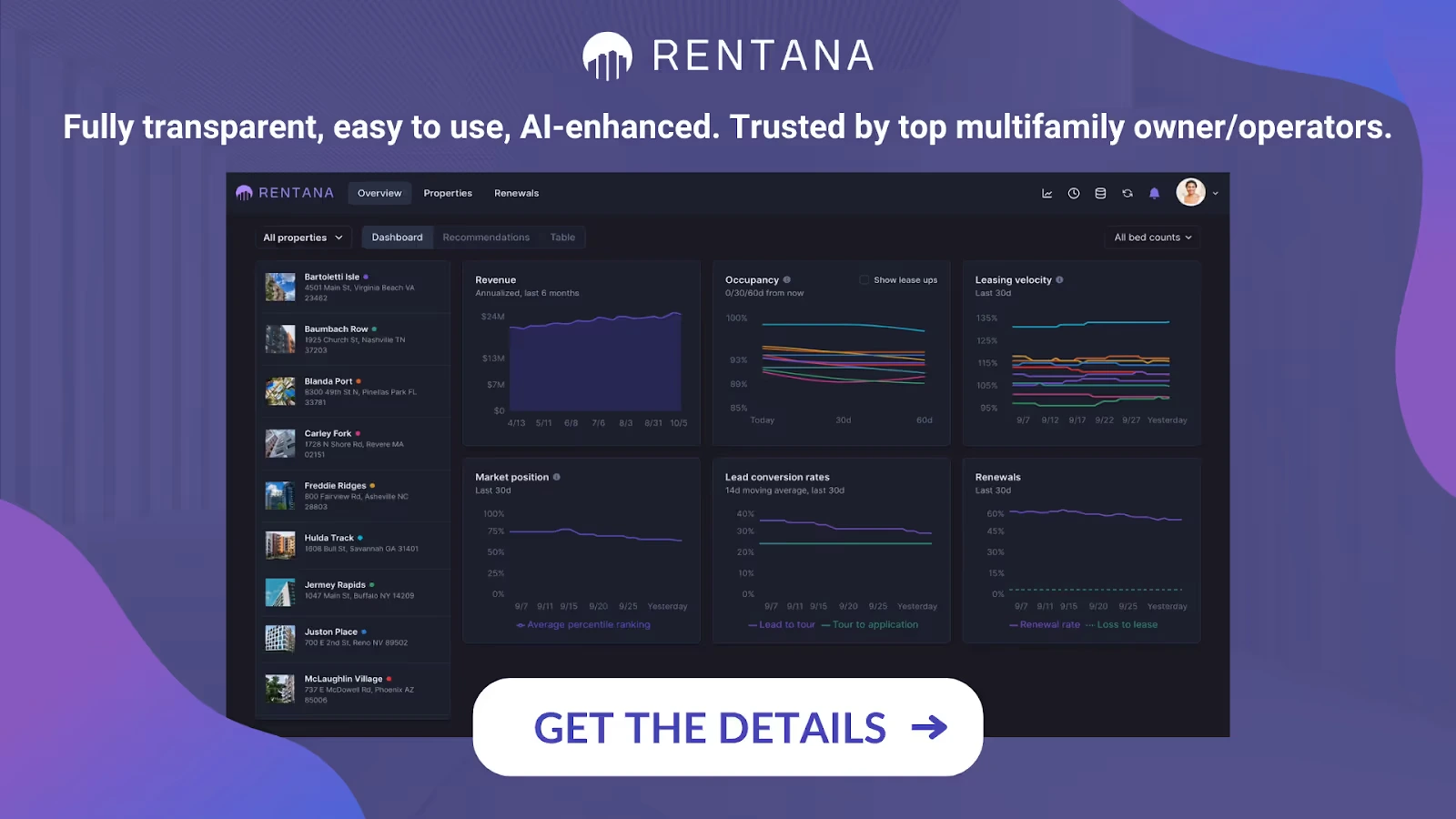
Rentana provides portfolio dashboards that allow operators to move from a high-level view of portfolio performance into individual properties and even down to floorplan-level insights. This makes it easier to identify outliers across assets, compare pricing performance, and maintain consistency across assets.
Teams can prioritize where to focus attention based on leasing velocity, and exposure signals rather than reviewing each property individually.
This portfolio-level visibility ensures that pricing decisions are not only accurate at the unit level but also aligned with broader portfolio objectives.
Read Also:
- Choosing a Multifamily Market Analytics Software: A Guide
- The Best Real Estate Market Analysis Tools
Key Capabilities That Support Analytics-Driven Pricing
Rentana supports this workflow through a set of integrated capabilities:
- Leasing velocity analysis to monitor demand across properties and unit types
- Predicted availability forecasting to understand how supply will develop over time
- Dynamic pricing recommendations based on operational signals and public market data
- Floorplan performance insights to evaluate demand at the unit type level
- Renewal strategy configuration aligned with current pricing conditions
- Expiration exposure visualization to identify and manage lease clustering
- Portfolio dashboards for portfolio-wide visibility and analysis
- AI-generated insights that explain pricing recommendations and support decision-making
Conclusion
Pricing does not operate in isolation. It reflects everything happening across a portfolio.
Leasing momentum, renewal behavior, availability patterns, and market conditions all shape how units perform. When those signals are disconnected, pricing becomes reactive and inconsistent. When they are connected, pricing becomes a tool for guiding performance.
This is the shift happening in multifamily operations.
Operators are moving away from periodic pricing decisions and toward a model where pricing is continuously informed by leasing activity and portfolio conditions. The goal is not simply to set rents, but to understand how pricing decisions influence what happens next.
Platforms like Rentana support this shift by bringing together leasing velocity, predicted availability, renewal strategy, and exposure signals into a single workflow. With clear visibility into these factors and AI-supported insights, teams can make pricing decisions with greater context and consistency across their portfolios.
Because in modern multifamily operations, the advantage is not in having more data.It is in knowing how to use it to guide decisions before performance begins to change.