Managing one multifamily asset well is a specific skill. Managing a portfolio of ten or fifteen assets across different markets, investment strategies, and stages of the hold period is a different challenge entirely.
The instinct when portfolios grow is to standardize. Build a process, apply it everywhere, and scale through consistency. That instinct is right about the consistency part and wrong about the everywhere part. Scalable multifamily management depends on consistent workflows, but those workflows need to allow for asset-level differences.
A stabilized asset needs a management approach built around maintaining occupancy within a defined range, protecting effective rent, managing renewals, and watching future exposure. A value-add property mid-renovation needs targets and pricing guardrails that reflect its current phase, renovation schedule, availability constraints, and premium validation. A partially renovated asset may need a different approach again, especially if classic, partially upgraded, and fully renovated units are competing within the same property.
Applying the same framework to all of these assets produces decisions that may look consistent but do not necessarily support performance. The stabilized asset can be managed as if it needs to fill units quickly. The value-add asset can be benchmarked against targets that do not reflect its renovation phase. The partially renovated asset can miss the pricing and positioning differences between product types that matter most to demand.
According to Multifamily Executive, operational performance will define multifamily success in 2026, with residents increasingly evaluating properties by how efficiently they are managed rather than by amenities alone. The article also notes that operators who adopt scalable systems will be better positioned to compete, navigate uncertainty, and unlock performance gains.
In that environment, the operators who scale most effectively are not the ones using the simplest uniform process. They are the ones building systems that create consistency where consistency helps, while preserving the flexibility needed to manage different assets according to their specific strategy.
This article covers nine multifamily management strategies that can scale across diverse portfolios, and how the right platform infrastructure can help teams maintain visibility, coordination, and asset-level flexibility without creating a separate operational playbook for every property.
Related:
Why Different MultifamilyAssets Require Different Management Approaches
Not every multifamily asset should be managed the same way, and treating them as if they should is one of the most common sources of operational misalignment in growing portfolios.
A stabilized asset is typically trying to maintain occupancy within a defined range while protecting effective rent, managing renewal performance, and limiting unnecessary concession pressure. A value-add asset mid-renovation is operating under different conditions. It may have temporary vacancy, staggered renovation timelines, evolving product quality, and pricing that needs to reflect both current availability and the premiums being tested on upgraded units.
A partially renovated property may be more complex still. Classic units, partially upgraded units, and fully renovated units may each require different pricing, leasing, and positioning strategies. Managing all of them as one generic asset can obscure the differences that actually influence performance.
The management strategies that work at scale are the ones that accommodate these differences without creating unnecessary operational complexity. That means:
- Configurable occupancy targets and leasing velocity expectations set at the property level rather than applied uniformly across the portfolio
- Pricing guardrails and renewal approaches that reflect each asset’s strategy, product mix, and stage of execution
- Performance benchmarks that measure each asset against its own objectives rather than against a portfolio average that obscures the differences that matter
- Shared visibility across teams so leasing, revenue management, and asset management are working from the same information
- Forward visibility into current conditions and future availability so teams can evaluate risk and opportunity in the context of each asset’s strategy
Scalable management is not one-size-fits-all management. It is the ability to apply consistent operating discipline while allowing the strategy, targets, and decision parameters to flex by asset.
9 Best Multifamily Management Strategies That Work
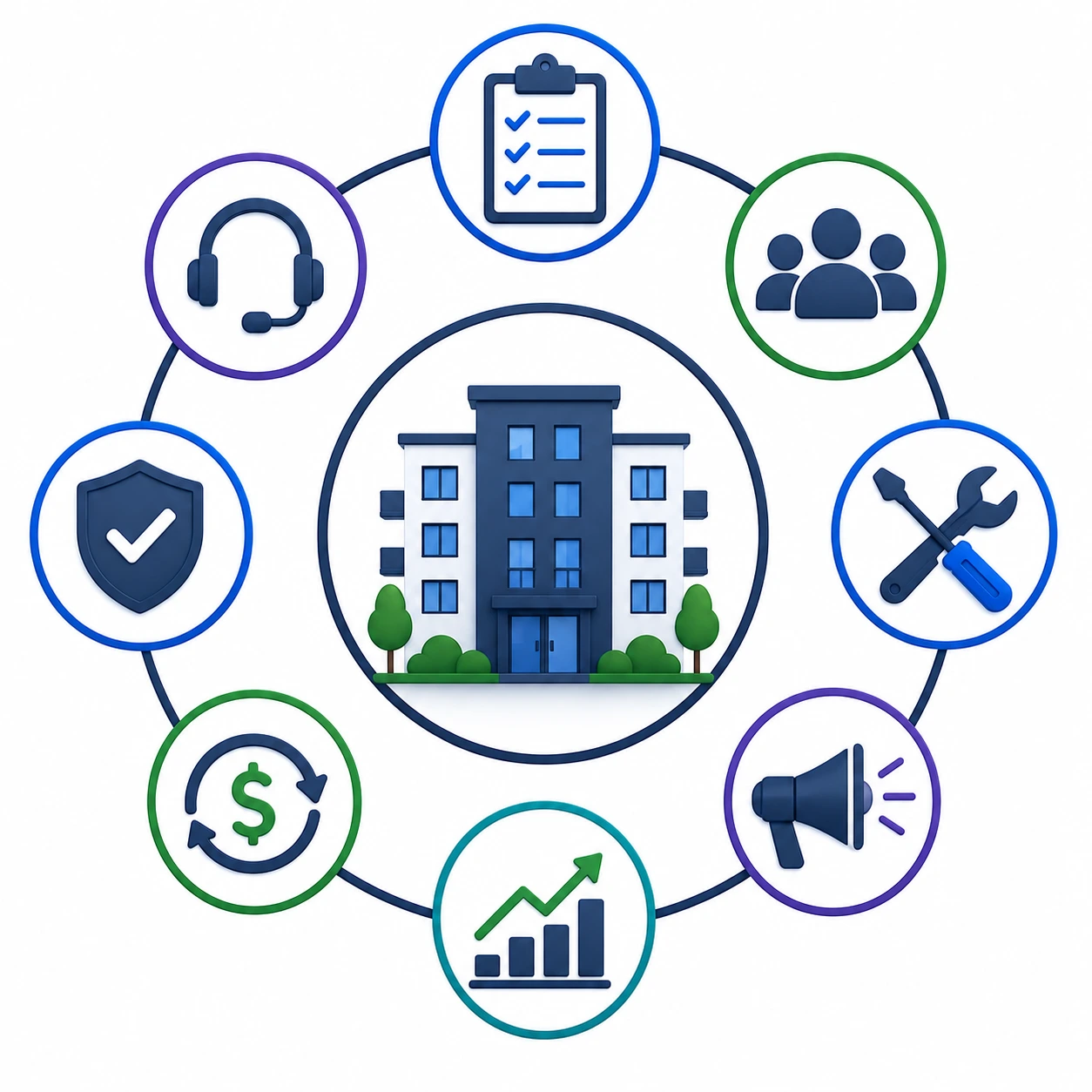
- Configure Asset-Level Goals and Targets
- Create Portfolio Visibility With Property-Level Detail
- Standardize Workflows While Customizing Parameters
- Review Leading Indicators Before Results Move
- Connect Leasing, Pricing, and Renewal Decisions
- Manage Expiration Exposure Across the Portfolio
- Give Teams a Shared Operating View
- Prioritize Assets That Need Attention
- Reduce Manual Reporting and Data Assembly
1. Configure Asset-Level Goals and Targets
The foundation of scalable multifamily management is not a uniform process. It is a configurable one. Each asset in a portfolio needs occupancy targets, leasing velocity expectations, pricing guardrails, and renewal approaches that reflect its specific strategy, product mix, and stage of execution.
A stabilized asset configured to maintain occupancy within a defined range is being managed differently from a value-add asset that is still working through renovations, testing rent premiums, and managing temporary availability. That difference is intentional. The management system should support it rather than flatten it into a portfolio-wide target that may not fit either asset.
Rentana’s property-level configuration allows operators to set occupancy targets, pricing guardrails, and leasing velocity expectations at the asset level. That means recommendations and performance context can reflect what each asset is actually trying to achieve, rather than applying the same assumptions across properties with different business plans.
Related:
- Multifamily Asset Management: A Complete Guide for Asset Managers
- How to Improve Multifamily Asset Management
2. Create Portfolio Visibility With Property-Level Drill-Down
Scaling management across multiple assets requires two kinds of visibility at the same time: a fast portfolio-level read on where attention may be needed, and the ability to move quickly into the property-level detail behind that signal. Without both, the portfolio view is either too broad to support action or the property detail requires too much manual assembly before it becomes useful.
The strongest portfolio management systems help teams understand which assets are stable, which may need closer review, and what conditions are contributing to that change. When something stands out at the portfolio level, teams should be able to move into the relevant unit group, leasing funnel stage, pricing condition, or availability issue without waiting for a separate report request.
Rentana supports this through portfolio dashboards that provide a shared view of asset performance across the portfolio, with the ability to review property-level and unit-group detail when additional context is needed. This helps teams move from portfolio signal to operating context more efficiently, so attention can be focused where it is most useful.
3. Standardize Workflows While Customizing Parameters
Standardization and customization are not opposites in multifamily management. They are key multifamily management strategies. The most scalable operations standardize the workflow structure while customizing the decision parameters within that workflow. Pricing reviews, renewal processes, performance reviews, and portfolio check-ins can follow a consistent cadence without forcing every asset to operate under the same targets or constraints.
This distinction is what allows a team managing fifteen assets to apply consistent operating discipline across the portfolio while still respecting asset-level differences. A stabilized asset, a value-add asset, and a partially renovated asset may all move through the same review process, but the targets, guardrails, and decision context inside that process should reflect each asset’s strategy.
The result is consistency in how decisions get reviewed and flexibility in what those decisions are designed to achieve. That combination is what makes management practices genuinely scalable rather than merely uniform.
4. Review Leading Indicators Before Results Move
Monthly reports describe what already happened. By the time a leasing slowdown, renewal conversion decline, or expiration concentration appears in a financial report, the conditions driving it may have been developing for weeks. Managing portfolio performance from lagging metrics alone means teams are often responding after the issue has already affected results.
Leading indicators such as leasing velocity trends, renewal conversion rates, notices to vacate, future availability, and expiration concentration help teams evaluate changing conditions earlier. The goal is not to predict outcomes with certainty. It is to understand what current activity suggests may happen next, so teams have more time to evaluate options before performance pressure becomes fully visible in reported results.
Predicted Occupancy shows what is anticipated to happen under current conditions by connecting current leasing activity, renewal trends, and future availability. When reviewed alongside exposure data and leasing performance, it gives teams a clearer view of whether current activity is aligned with the asset’s occupancy and revenue objectives.
Read Also:
- Multifamily Asset Valuation: Complete Guide
- Multifamily Asset Performance: 7 Key Strategies
5. Connect Leasing, Pricing, and Renewal Decisions
Connecting leasing, pricing, and renewals are important multifamily management strategies. They are also not independent functions. A pricing adjustment affects leasing velocity. Leasing velocity affects future availability. Future availability affects how renewal offers should be calibrated. Managing these decisions in separate conversations, with separate data, on separate timelines, creates misalignment that can compound into performance gaps.
Scalable management requires these decisions to be informed by the same operating context. When the team reviewing pricing can evaluate leasing velocity and future availability alongside the recommendation, and when the team managing renewals can understand how exposure is building in specific unit groups, the decisions that follow are more coherent.
Rentana connects leasing velocity signals, renewal conversion trends, exposure forecasting, pricing recommendations, and asset strategy configuration into a shared operating view. That helps teams evaluate leasing, pricing, and renewal conditions together rather than through disconnected workflows that each reflect only part of the picture.
6. Manage Expiration Exposure Across the Portfolio
Lease expiration concentration is one of the most consistently under-managed risks in multifamily, partly because it is a future availability issue that may not appear in current occupancy results. Tracking it manually across unit types, properties, and time windows becomes increasingly difficult as portfolios grow.
At portfolio scale, this problem multiplies. A concentration building at one asset may be manageable. The same concentration building across several assets in the same leasing window can create a very different risk profile. That risk is easier to evaluate when expiration data is reviewed across the portfolio rather than property by property.
Rentana helps teams evaluate expiration concentration by property, unit group, and time window, incorporating notices to vacate, month-to-month behavior, and early terminations into the future availability picture. This gives teams more time to assess whether adjustments to lease terms, renewal strategy, pricing, or leasing focus may be needed before availability pressure becomes harder to manage.
7. Give Teams a Shared Operating View
One of the most consistent sources of operational misalignment in growing portfolios is teams working from different information at the same time. Leasing may be focused on pipeline activity. Revenue management may be focused on pricing recommendations. Asset management may be reviewing occupancy, exposure, and financial performance. When each team is working from a different report or system, coordination starts with reconciliation instead of strategy.
Shared visibility does not just make reporting cleaner. It changes the quality of team conversations. When leasing, revenue management, operations, and asset management are aligned around the same view of current conditions, meetings can move more quickly from “what is happening?” to “what does it mean, and how should we evaluate it?”
Rentana supports this by giving leasing, revenue management, and asset management teams access to a shared operating view across the portfolio. When conditions at a property or unit group require closer review, the relevant teams can work from the same performance context rather than waiting for separate reports or one-off analysis.
Related:
8. Prioritize Assets That Need Attention
In a portfolio of ten or fifteen assets, not every property needs the same level of attention at the same time. Without a connected portfolio view, attention can be distributed based on the loudest issue, the most recent report, or the property that happens to be on the meeting agenda. That is not prioritization. It is reactive allocation of a limited resource.
Effective portfolio management requires a more consistent basis for directing attention. An asset where leasing velocity is softening, renewal conversion is declining, and expiration exposure is building may deserve closer review than one that is stable across the same dimensions. That ordering is only clear when teams can evaluate multiple signals side by side across the portfolio.
Rentana’s AI-generated property insights help teams understand what is changing at specific assets, why it may matter operationally, and which factors may be contributing to the shift. This helps operators identify where multiple conditions may warrant closer review, so attention can be focused where it is most likely to support performance.
9. Reduce Manual Reporting and Data Assembly
At portfolio scale, the time spent building reports before analysis can begin is one of the most consistent drags on operational efficiency. Pulling data from the PMS, reconciling it with other systems, formatting it for ownership or internal reviews, and repeating the process weekly or monthly consumes time that should be spent evaluating performance and making decisions.
Scalable reporting infrastructure reduces that burden by giving teams consistent access to current performance information across assets. The goal is not simply to make reports look cleaner. It is to reduce the manual work required to understand what is happening, compare performance across properties, and prepare teams for better operating conversations.
Rentana integrates with existing property management systems and brings leasing, occupancy, pricing, renewal, and performance information into a shared portfolio view. Portfolio dashboards and reporting tools help asset managers, ownership groups, and operating teams access the information they need without requiring every review to start with manual data assembly.
Don’t Miss:
- Multifamily Marketing Strategies that Actually Drive Leasing
- How To Do A Rental Market Analysis Like a Pro (With AI Tools)
Conclusion on Multifamily Management Strategies
Scaling multifamily management is not about applying the same process to every asset. It is about building systems that create consistency where consistency helps while preserving the flexibility needed to manage different assets according to their specific strategy, stage, and performance objectives.
The nine multifamily management strategies in this article all support that balance. Asset-level goals, configurable parameters, shared operating views, connected leasing and revenue decisions, exposure management, prioritization, and scalable reporting all help operators manage diverse portfolios without creating unnecessary complexity.
The operators who scale most effectively are not the ones with the most standardized processes. They are the ones whose systems make it easier for teams to see what is changing, understand why it matters, and coordinate decisions around the strategy each asset is actually meant to execute.