
Every analytics platform, AI tool, and reporting dashboard in multifamily is only as useful as the data feeding it. That sounds obvious. In practice, it is one of the most consistently overlooked reasons why operators invest in better technology and still end up with outputs they cannot fully trust.
Data quality problems rarely appear as obvious failures. It produces pricing recommendations influenced by inconsistent operational inputs rather than actual unit performance. It generates occupancy projections built on availability statuses that nobody updated. It creates conversion reports that misattribute leads because the source tracking was inconsistent from the start. The platform is working exactly as designed. The problem is upstream.
According to Multifamily Dive, real estate organizations generate vast amounts of data, but AI is only as powerful as the data it is fed, and without a well-defined data strategy, AI tools may produce misleading results, overlook critical patterns, or fail to integrate with existing workflows. That applies equally to occupancy reports, pricing recommendations, renewal conversion tracking, and exposure forecasting. None of them are immune to what the underlying data actually says.
A multifamily data audit in multifamily is not a one-time IT exercise. It is an ongoing operational discipline that directly affects the quality of every decision that flows from the data. This article covers what that operational discipline looks like in practice, where the most common data quality issues appear, how teams can audit for them, and how clean data directly improves the reliability of the outputs operators use to manage portfolio performance.
Related:
- Best Leasing Solutions for Managing Multiple Multifamily Assets
- The Best Multifamily Pricing Tool for Investors
The Most Common Data Quality Problems in Multifamily Operations
Data quality problems in multifamily operations rarely present as obvious errors. They look like slightly inconsistent tagging across properties, availability statuses that are operationally inconsistent, and lead source attribution that seemed fine until someone tried to use it for a conversion analysis. Individually, many of these issues appear minor. Collectively, they create operational outputs that become increasingly difficult to trust and interpret reliably over time.
1. Inconsistent Unit Tagging Across Properties
Floor tags, view tags, and amenity tags that are incomplete, inconsistently applied, outdated, or layered on top of one another create operational noise that becomes difficult to untangle over time. The issue is not just whether tags exist. It is whether the tagging structure accurately reflects the unit features and pricing logic the property is actually trying to manage.
In practice, many portfolios accumulate tagging inconsistencies gradually. Floor premiums may exist on some units but not others. View tags may be missing entirely from portions of the property. Older single-use tags created for temporary operational situations, such as legacy loss-leader units or outdated renovation classifications, often remain in place long after the original reason for the tag no longer applies. Over time, overlapping premiums and inconsistent tagging structures make it increasingly difficult to understand which pricing layers are actually influencing leasing behavior and which are simply creating operational distortion.
A clean tagging audit is not about comparing amenity performance across assets. It is about ensuring the amenity and unit configuration structure is complete, consistent, interpretable, and aligned with how the property is actually intended to operate today.
2. Incorrect or Outdated Unit Availability Status in the PMS
Availability status issues in multifamily operations extend beyond units simply being marked occupied or vacant incorrectly. Incorrect move-in dates, lease start dates, lease end dates, notice dates, or make-ready timelines all distort the operational picture that leasing, exposure forecasting, and occupancy projections rely on to function accurately.
In practice, these inconsistencies often come from operational timing gaps rather than missing data entirely. Units may remain unavailable in the PMS after becoming ready to lease. Applications may not be attached to units on the correct dates. Lease dates may be updated late after execution. Units under renovation may sit without a status that accurately reflects their true leasing timeline. Individually, many of these discrepancies appear minor. Collectively, they distort occupancy and leased percentages, forward exposure visibility, leasing velocity analysis, and availability forecasting in ways that become increasingly difficult to identify later.
This is one of the most operationally significant data quality issues in multifamily because so many downstream analytics rely on availability timelines being accurate and updated consistently in real time.
3. Lead Source Tracking Errors
Lead source attribution inconsistencies distort visibility into where qualified prospects are actually originating. A marketing team making spend decisions based on conversion data that is incorrectly attributing leads is optimizing toward a picture that does not reflect reality. Prospects tagged to the wrong source, leads with no source recorded, and duplicate entries that inflate volume on specific channels all produce conversion analysis that is unreliable at best and materially unreliable operationally.
The operational impact extends beyond reporting accuracy alone. Marketing resources can end up allocated toward channels that appear stronger than they actually are, while more effective sources receive less support because the underlying attribution data was inconsistent from the beginning.
4. Renewal and Lease Data Entry Inconsistencies
Renewal and lease execution workflows are only operationally useful when the timing and status definitions behind them are applied consistently across every property. In practice, many portfolios develop inconsistencies around what actually qualifies as an accepted renewal, when a renewal is considered complete, and how quickly lease execution steps are finalized after a resident verbally accepts an offer.
A resident agreeing to renewal terms without countersigning documents promptly, or onsite teams delaying lease execution follow-up until close to the expiration date, creates operational blind spots in renewal conversion tracking and forward exposure visibility. A renewal that appears operationally secure may still represent real vacancy risk if the lease has not been fully executed in a timely manner.
The same issue applies to lease data accuracy more broadly. Incorrect lease start dates, move-in dates, or lease terms distort expiration forecasting and predicted availability over time. Across larger portfolios, even relatively small inconsistencies in lease timing and execution workflows compound into forward exposure visibility that no longer reflects actual operational risk accurately.
Read Also:
5. Occupancy Calculations that Include or Exclude Units Inconsistently
Affordable units, model units, down units, and units under renovation can be included or excluded from occupancy calculations in different ways at different properties. When occupancy methodologies differ across assets, portfolio-level occupancy comparisons stop reflecting a fully comparable operational picture.
An operator looking at occupancy across a ten-asset portfolio where five assets include model units in the denominator and five do not is not looking at a consistent picture, even when each individual property calculation appears technically correct on its own.
What a Practical Multifamily Data Audit Actually Covers
A multifamily data audit does not need to be a months-long project. It needs to be a structured review of the specific data inputs that most directly affect the quality of the outputs teams are relying on. Here is what that looks like in practice across the five areas that matter most.
1. Unit Configuration Review
Start with unit tagging. Pull a full list of every unit across the portfolio and check for floor tags, view tags, and amenity tags. The objective is not simply that tags exist, but that they are defined and applied consistently across the portfolio. If corner units are tagged at some properties and not others, if renovation tiers are defined differently across assets, or if view categories do not match across comparable properties, the tagging needs to be standardized before any amenity performance analysis can be trusted.
For every unit type that lacks a tag, the question is not whether the feature warrants a premium. It is whether the feature is being tracked at all. A placeholder tag that can be monitored and refined over time is operationally more useful than a missing classification that leaves a permanent blind spot in the data structure.
2. Availability Status Audit
For a proper multifamily data audit, Pull current availability data from the PMS and compare it against actual unit conditions on the ground. Check for units on notice that are still showing as occupied, units that have vacated but have not been updated, and units under renovation without a clear status that reflects their actual availability timeline.
This audit is most valuable when done on a regular cadence rather than as a one-time exercise. Availability status drifts constantly as units turn over, notices come in, and make-ready timelines shift. A monthly availability status review that catches and corrects discrepancies before they accumulate is significantly more valuable than an annual audit that finds months of compounded inaccuracies.
3. Lead Source and Funnel Data Review
Review how leads are being attributed across properties. Check for leads with no source recorded, sources that are inconsistently named across properties making them impossible to aggregate, and any manual overrides or workarounds that are introducing attribution errors.
Then follow the funnel. Check whether leads are being tracked through each conversion stage consistently, from inquiry to tour to application to lease. If the funnel stages are not being recorded consistently across properties, conversion rate analysis by stage is not comparable across assets and cannot support reliable marketing spend decisions.
4. Renewal and Lease Data Validation
Establish a consistent definition of when a renewal is recorded as accepted across every property in the portfolio. If some properties record it at offer acceptance and others at lease signing, the renewal conversion data is not comparable and any portfolio-level trend analysis built on it will reflect the recording inconsistency as much as actual resident behavior.
Check lease data for consistency in how start dates, move-in dates, and lease terms are recorded. Any inconsistency in how lease terms are captured affects expiration tracking accuracy, which flows directly into exposure forecasting. A 13-month lease recorded as a 12-month lease at one property creates an expiration date that is a month off, which compounds across a portfolio with hundreds of leases into a forward exposure picture that does not reflect actual risk.
5. Occupancy Calculation Review
Document exactly which units are included and excluded from occupancy calculations at every property. Model units, affordable units, down units, and units under renovation should be treated consistently across every asset in the portfolio and across every reporting period.
If the methodology is not documented and consistently applied, the occupancy numbers are not comparable across assets, and any portfolio-level analysis built on them will reflect methodology differences as much as actual performance differences. T
This is particularly important for operators with mixed portfolios that include both market-rate and affordable units, where blending without separate calculation methodologies produces numbers that are difficult to interpret and impossible to act on accurately.
Related:
- AI Leasing Assistants for Multifamily Teams
- Multifamily Analysis Spreadsheet: Alternatives for Operators
How Rentana Helps with Multifamily Data Audits
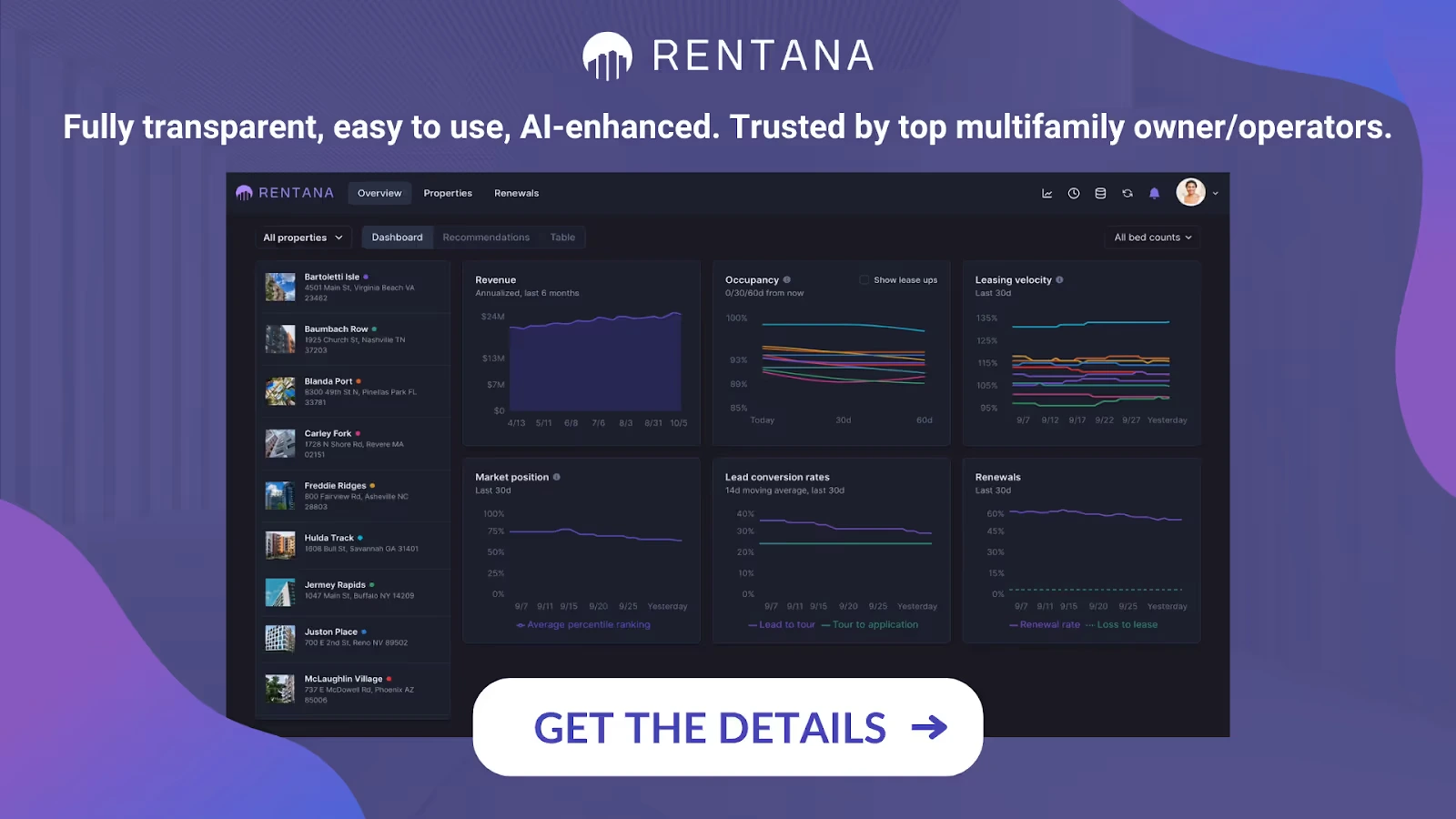
Each of the multifamily data audits covered in the previous section maps directly to a platform capability that becomes more reliable when the underlying data is clean. This is not an abstract data quality argument. It is a specific, practical connection between what gets fixed in a data audit and what improves in the output teams are working from every day.
1. Consistent Unit Tagging Enables Reliable Amenity Performance Analysis
When floor tags, view tags, and amenity tags are complete, current, and consistently applied across a property, amenity performance analysis becomes significantly more interpretable operationally. The issue is not comparing amenity performance across assets. It is ensuring the pricing and configuration structure within each property accurately reflects the unit characteristics and operational logic teams are actually trying to manage.
Incomplete or outdated tagging structures create operational distortion that becomes difficult to identify later. Missing floor premiums, inconsistent view tags, overlapping pricing layers, outdated renovation classifications, or legacy one-off tags originally created for temporary operational situations all affect how leasing performance is interpreted over time.
Rentana’s amenity performance analysis is most useful when the underlying tagging structure is clean, comprehensive, and operationally current. That allows teams to evaluate whether specific unit characteristics are leasing in line with expectations, whether pricing layers are creating unnecessary friction, and whether operational configuration drift has accumulated over time in ways that are no longer aligned with current leasing behavior.
2. Clean Lead Source Data Enables Reliable Funnel Conversion Tracking
When leads are correctly attributed and tracked through each conversion stage consistently. Clean funnel data makes leasing velocity and conversion analysis significantly more operationally useful because teams can distinguish between traffic issues and conversion issues more reliably. Rentana surfaces those distinctions through leasing velocity and funnel conversion visibility tools.
That distinction helps teams align operational response more appropriately to the actual source of the leasing issue. A property with healthy inquiry volume but low tour-to-application conversion has a different problem than one with low inquiry volume and strong conversion on the prospects who do come through.
When lead source data is inconsistently recorded or leads are misattributed, that distinction becomes unreliable. The funnel may appear healthier or weaker than actual leasing conditions would suggest, and the responses that follow are calibrated to a picture that does not reflect what is actually happening in the pipeline.
Read Also:
- Amenity Fee Pricing: How Multifamily Operators Get It Right
- Top 7 Multifamily Revenue Optimization Strategies
3. Accurate Availability Status Improves Predicted Occupancy Reliability
Rentana’s predicted occupancy relies on leasing activity, expiration visibility, and availability timelines to evaluate forward occupancy conditions.The reliability of that projection depends directly on whether the underlying lease dates, notice dates, availability statuses, and unit readiness timelines accurately reflect actual operating conditions.
Incorrect move-in dates, delayed lease execution updates, units left unavailable after becoming rent-ready, applications attached to units late, or renovation units sitting in unclear statuses all distort the forward operational picture the platform is evaluating. Individually, many of these discrepancies appear minor. Across larger portfolios, they compound into occupancy forecasts and exposure visibility that no longer fully reflect actual leasing conditions.
Regular availability and lease timeline audits are one of the most direct ways operators can improve the reliability of predicted occupancy outputs and forward exposure analysis over time.
4. Consistent Renewal Data Improves Retention Risk Analysis
Rentana’s renewal dashboards and conversion tracking are most reliable when renewal workflows and lease execution timing are handled consistently across properties. A resident verbally accepting renewal terms without promptly countersigning documents, delayed follow-up from onsite teams, or inconsistent definitions of when a renewal is considered operationally complete all distort forward retention visibility over time.
A renewal may appear operationally secure while still representing meaningful vacancy risk if lease execution has not been finalized early enough in advance of expiration. Across larger portfolios, these workflow inconsistencies gradually weaken the reliability of renewal conversion reporting, forward exposure forecasting, and retention trend analysis.
Consistent lease execution timing, standardized renewal status definitions, and proactive follow-up processes are what allow renewal dashboards and conversion metrics to reflect actual retention conditions rather than operational process inconsistencies.
5. Consistent Occupancy Calculations Support Reliable Portfolio-level Insights
Portfolio-level operational insights are only reliable when occupancy methodologies are consistent across assets. Rentana’s portfolio dashboards and operational insights rely on that consistency to support cross-portfolio visibility.
Cross-portfolio operational analysis is only reliable when the underlying occupancy calculations are based on consistent methodology across every asset. When occupancy methodologies differ across properties, the portfolio-level picture reflects those methodology differences alongside actual performance differences, which makes it harder to distinguish between an asset that is genuinely drifting and one that just calculates occupancy differently.
Documenting and standardizing occupancy calculation methodology across every asset is the foundational step that makes portfolio-level analysis reliable rather than directionally useful but operationally inconsistent.
Related:
- How to Forecast Occupancy in Multifamily Real Estate
- How to Calculate Occupancy Rate (Formula + Examples)
What Rentana Surfaces When Data Quality Gaps Exist
One of the practical advantages of working in a platform with transparent recommendations and reasoning is that data quality problems often become visible in the outputs before anyone has run a formal audit. A pricing recommendation that seems inconsistent with what the leasing team is observing on the ground. A predicted occupancy projection that does not match the team's read on actual pipeline. A renewal conversion trend that looks different from what property-level reporting is showing.
These discrepancies are often worth investigating rather than dismissing immediately. They are frequently the first operational indicator that underlying data may not fully reflect actual property conditions, and they point toward the specific audit area worth reviewing. The transparency behind Rentana’s recommendations and operational insights helps make those inconsistencies more visible rather than allowing them to remain hidden inside outputs that appear operationally reasonable on the surface.
Conclusion on Data Audits for Multifamily
Data quality is ultimately an operational discipline rather than simply a technology issue. It determines whether the analytics, recommendations, and projections a platform produces are reliable enough to support operational decision-making.
The five multifamily data audits areas covered in this article, unit tagging, availability status, lead source attribution, renewal data consistency, and occupancy calculation methodology, are not complicated to review. What they require is a regular cadence and a clear standard applied consistently across every asset in the portfolio.
A multifamily data audit is not a one-time correction effort. It is the ongoing operational work that helps keep portfolio insights, recommendations, forecasts, and reporting aligned closely enough with actual property conditions to support operational decisions teams can trust over time.