Did you know that AI adoption among property managers surged from 21% in 2024 to 34% in 2025, with another 29% of operators planning to implement AI tools in the near future. This makes AI one of the fastest growing technology adoption trends across the multifamily industry.
That distinction matters more than it might seem. The AI tool category for multifamily property management has grown fast enough that the label now covers everything from chatbots that answer leasing inquiries to platforms that connect pricing, occupancy signals, and portfolio performance into a single operational view.
These are not the same kind of tool. They do not solve the same problems. And deploying the wrong category for the wrong use case produces the outcome that most operators want to avoid, another system to manage without a meaningful improvement in how decisions get made.
This article organizes the best AI tools for multifamily property management by use case rather than by vendor. The goal is to help operators match the right tool category to the specific operational problem they are trying to solve, before committing to a platform that may be well built for a different problem than the one they actually have.
Related:
7 Best AI Tools for Multifamily Property Management by Use Case
- AI Resident Communication and Virtual Assistant Tools
- AI Leasing Automation Tools
- AI Reporting and Analytics Tools
- AI Maintenance & Operations Tools
- AI Pricing and Revenue Management Tools
- General Purpose AI Tools for Productivity
- AI Revenue Intelligence & Asset Performance Platforms
1. AI Resident Communication and Virtual Assistant Tools
The problem it solves: Multifamily teams manage a constant stream of resident communication, from after-hours maintenance emergencies and lockouts to package questions, amenity reservations, policy inquiries, and lease-related requests. Residents increasingly expect quick responses regardless of when a question is asked, but onsite teams cannot realistically be available around the clock.
The challenge is providing timely, consistent communication while ensuring residents feel supported and important requests are routed appropriately.
What good tools in this category do: AI-powered communication tools help residents access information, submit requests, schedule appointments, and receive updates when they need them, including evenings and weekends when leasing offices may be closed. They can answer common questions, provide status updates, route maintenance requests, and help residents reach the right resource more quickly.
For property teams, these tools reduce administrative workload, improve response times, and create more capacity for resident interactions, operational issues, and situations that require human judgment and personal attention.
Who benefits most: Property managers and onsite teams supporting communities with high communication volume. These tools are especially valuable for larger communities and growing portfolios where resident inquiries, service requests, and routine communications can become difficult to manage consistently through manual processes alone.
What it does not solve: AI communication tools are designed to handle common questions, provide information, and route requests efficiently. They do not replace the judgment, empathy, and relationship management required for sensitive resident situations, policy exceptions, disputes, emergencies, or complex problem solving. The goal is not to replace human interaction. It is to ensure residents receive timely support while allowing onsite teams to focus their attention where personal engagement matters most.
Example tools: Resident chatbots, virtual assistants, maintenance request triage tools, AI-powered messaging platforms, and automated communication systems.
2. AI Leasing Automation Tools
The problem it solves: Leasing teams lose prospects to slow response times, inconsistent follow-up, and the reality that inquiries arrive at all hours while leasing agents are only available during business hours. Prospects often contact multiple communities simultaneously and expect a timely response regardless of when they inquire. According to Propmodo, 61% of apartment seekers either already use or plan to use a chatbot in their apartment search, making AI-assisted communication increasingly common throughout the leasing process.
What good tools in this category do: AI leasing tools help ensure every inquiry receives a prompt response. They can answer common questions, qualify prospects based on move-in timeline, budget, and unit preferences, schedule tours without manual coordination, and automate follow-up throughout the leasing process.
The best tools maintain conversation history and pass relevant context to leasing agents at handoff, allowing the prospect experience to continue seamlessly when human interaction becomes necessary.
Who benefits most: Leasing teams managing high inquiry volume, properties with significant after-hours or weekend traffic, and operators looking to improve lead response consistency and tour conversion without adding additional headcount.
What it does not solve: AI leasing tools are highly effective at managing inquiry volume, scheduling, and routine follow-up. They do not replace the relationship-building, sales skills, and judgment required to convert prospects into residents or create the resident experience that drives long-term retention.
They also do not tell operators whether leasing activity is translating into stronger property performance, which requires separate visibility into conversion, occupancy, and revenue outcomes.
Example tools: AI leasing assistants, lead qualification tools, automated follow-up platforms, tour scheduling systems, and leasing chatbot solutions.
3. AI Reporting and Analytics Tools
The problem it solves: Most multifamily operators are pulling data from multiple systems, reconciling it manually, and building reports that are already partially outdated by the time they are reviewed. The process consumes time that should go toward analysis and decision-making, while making it difficult to maintain a consistent view of performance across properties, teams, and reporting periods.
What good tools in this category do: AI reporting and analytics tools consolidate data from PMS, CRM, financial, and operational systems into a single view, reducing the manual effort required before analysis can begin. They help teams identify trends, compare performance across assets, and organize large amounts of information into dashboards, reports, and visualizations that are easier to understand and act on.
Who benefits most: Asset managers, property managers, regional operators, and ownership groups that spend significant time gathering, reconciling, and validating data before they can begin evaluating performance.
What it does not solve: Reporting and analytics tools primarily help users understand what has happened and how performance compares across assets, time periods, and benchmarks. They generally rely on users to determine which trends matter most and what actions should be considered. Tools that connect leasing activity, pricing, renewals, future availability, and operational performance into a more complete picture of changing asset conditions belong in a separate category covered later in this article.
Example tools: Business intelligence platforms, portfolio reporting systems, analytics dashboards, financial reporting tools, and data visualization platforms.
Read Also:
- Top 9 AI Applications in Real Estate
- Will AI Replace Real Estate Agents? Or Transform Them?
4. AI Maintenance & Operations Tools
The problem it solves: Multifamily operations teams are responsible for coordinating a large number of moving parts simultaneously, including work orders, preventative maintenance, inspections, vendor management, unit turns, and resident service requests. As portfolios grow, maintaining consistency and visibility across these operational workflows becomes increasingly difficult, particularly when information is spread across multiple systems or dependent on manual follow-up.
What good tools in this category do: AI maintenance and operations tools help teams organize, prioritize, and manage operational workflows more efficiently. They can assist with work order routing, maintenance scheduling, vendor coordination, inspection tracking, preventative maintenance planning, and identifying operational bottlenecks that may affect resident experience or property performance.
The best tools help ensure that routine operational tasks are completed consistently while providing teams with better visibility into service delivery and execution.
Who benefits most: Property managers, maintenance leaders, regional operators, and operations teams responsible for maintaining service levels across one or more communities.
What it does not solve: Operations tools can improve workflow efficiency and visibility, but they do not replace the skilled technicians, vendors, managers, and onsite teams responsible for executing the work. They can help prioritize tasks and coordinate resources, but they cannot solve underlying staffing shortages, deferred maintenance issues, capital investment needs, or operational leadership challenges on their own.
Example tools: Maintenance management platforms, work order automation systems, vendor coordination tools, inspection management software, preventative maintenance solutions, and operational workflow platforms.
5. AI Pricing and Revenue Management Tools
The problem it solves: Pricing decisions in multifamily have traditionally been made using a combination of comp surveys, occupancy reports, and experience-based judgment. While all of those inputs remain valuable, they often provide only part of the picture.
Effective pricing decisions also require visibility into leasing activity, future availability, asset objectives, and current operating conditions, all of which can be difficult to evaluate consistently across multiple unit types and properties and goals.
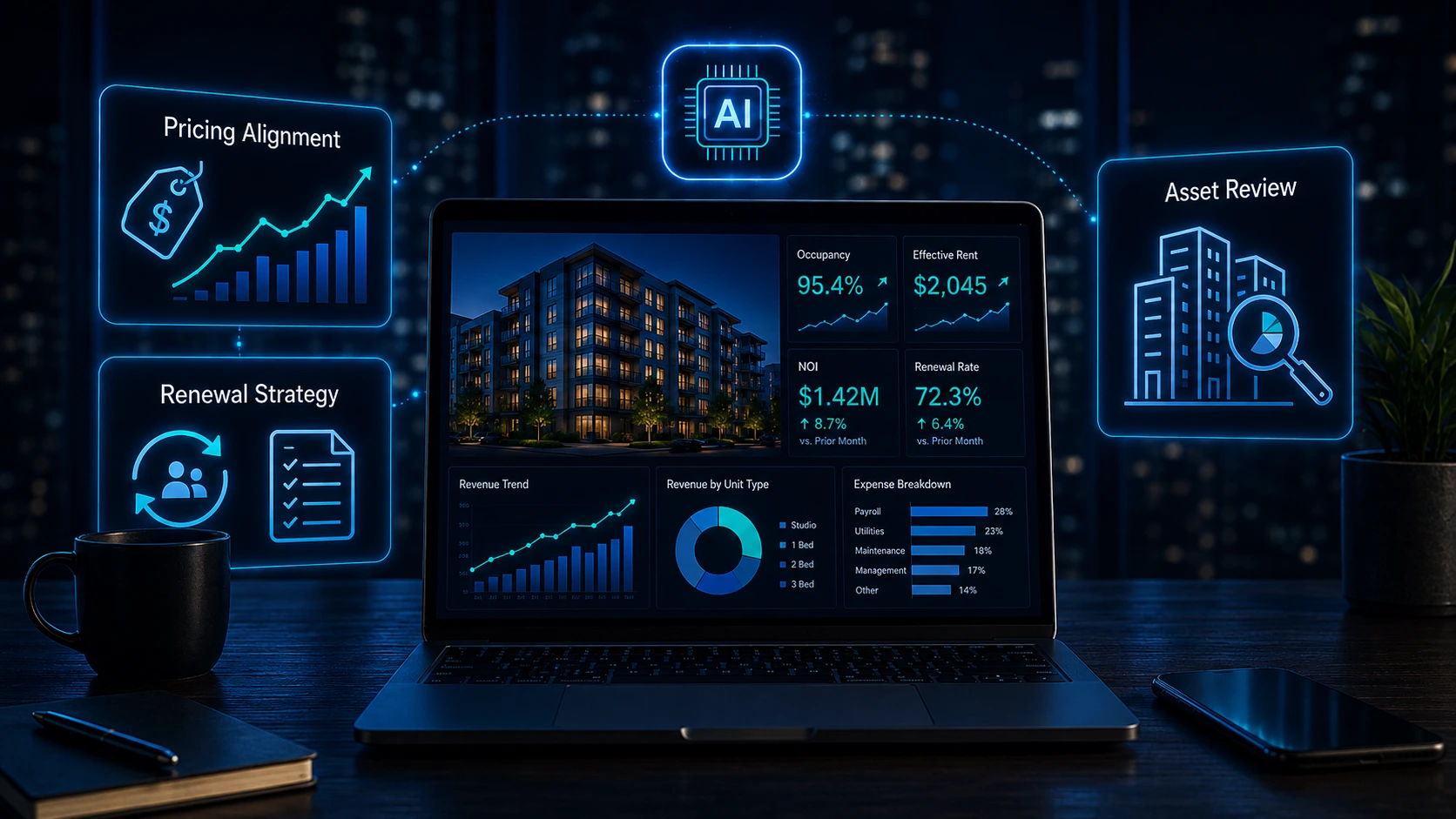
What good tools in this category do: AI pricing and revenue management tools generate pricing recommendations at the bedroom type or custom unit-group level using a combination of leasing activity, future availability conditions, public market information, and the asset strategy configured by the operator.
The best tools provide transparency into the factors influencing each recommendation so teams can understand the reasoning, apply their own judgment, and make decisions with confidence.
Rentana's pricing recommendations work this way. Recommendations are generated at the bedroom type or custom unit-group level and reflect the operator's configured occupancy goals, target timeframes, and broader asset strategy. Every recommendation includes visibility into the factors influencing the recommendation before any pricing decision is made.
Who benefits most: Revenue managers, asset managers, and operators responsible for pricing decisions across multiple unit types and properties, particularly those currently relying on manual comp surveys, spreadsheets, and periodic reviews to guide pricing strategy.
What it does not solve: Pricing tools help answer one question exceptionally well: what should we charge? They do not provide a complete view of overall asset performance. Understanding how pricing decisions connect to leasing trends, renewal performance, future availability, portfolio priorities, and broader operating conditions requires a separate category focused on revenue intelligence and asset performance.
Example tools: Revenue management systems, pricing optimization platforms, rent recommendation tools, automated pricing software, and multifamily revenue management solutions.
6. General Purpose AI Tools for Productivity
The problem it solves: Multifamily professionals spend a significant amount of time writing emails, summarizing meetings, documenting conversations, preparing ownership updates, drafting resident communications, and organizing information from multiple sources. While these tasks are important, they can consume time that would otherwise be spent on residents, operations, leasing activity, and asset performance.
What good tools in this category do: General-purpose AI tools such as ChatGPT, Claude, and Gemini help users create first drafts, summarize documents, organize information, explain unfamiliar concepts, and brainstorm ideas more quickly than manual processes alone. They are often the easiest category of AI tools to adopt because they require little setup and can support a wide range of day-to-day professional tasks across multifamily operations.
Who benefits most: Leasing agents, property managers, regional managers, asset managers, and executives who regularly spend time writing, reviewing, summarizing, or communicating information as part of their role.
What it does not solve: General-purpose AI tools are designed to assist with information and content creation, not provide property-specific operational intelligence. They do not have access to leasing activity, renewal performance, occupancy conditions, financial results, or other property-level data unless that information is manually provided by the user. Outputs should always be reviewed before use, particularly when communicating with residents, ownership groups, or other stakeholders where accuracy matters.
Example tools: ChatGPT, Claude, Gemini, Microsoft Copilot, and other general-purpose AI assistants.
Related:
- AI Adoption Challenges in Real Estate & How to Solve Them
- How AI Real Estate Assistants Help Operators
7. AI Revenue Intelligence & Asset Performance Platforms
The problem it solves: Most multifamily operators are not short on data. They are short on visibility into how conditions are changing across the portfolio, which performance signals deserve attention, and how leasing, pricing, renewals, occupancy, and future availability connect to one another. Pricing tools answer pricing questions. Reporting tools explain what happened. Revenue intelligence platforms help operators evaluate changing conditions across assets and prioritize where attention is needed most.
What good tools in this category do: Rentana is purpose-built for this category. Revenue intelligence platforms help teams move from reviewing disconnected metrics to understanding how changing conditions may affect asset performance. Instead of looking at leasing, renewals, pricing, occupancy, and future availability separately, these tools help operators evaluate how those signals connect and where additional attention may be needed.
For asset managers, revenue managers, and ownership groups, the value is not simply having more data in one place. It is having a clearer view of which performance changes matter, why they may matter operationally, and how they may influence occupancy, revenue, and asset performance if left unaddressed. This makes it easier for teams to prioritize review, align around the same information, and evaluate decisions in the context of the asset’s broader strategy.
Who benefits most: Multifamily operators managing multiple assets where performance visibility, prioritization, and coordination requirements extend beyond what property-level tools or traditional reporting platforms can provide. Asset managers, revenue managers, regional operators, and ownership groups benefit most from a shared view of changing conditions across the portfolio.
What it does not solve: Revenue intelligence platforms are designed to support evaluation and decision-making, not replace it. They do not function as acquisition platforms, construction management systems, resident experience tools, or substitutes for operational judgment. They perform best when underlying property data is accurate, consistently configured, and regularly maintained.
Example tools: Revenue intelligence platforms, asset performance visibility tools, AI-generated portfolio insights platforms, and multifamily revenue intelligence solutions.
You Might Like:
- AI Adoption in Multifamily: Why it's Accelerating So Fast
- Top 8 Uses of AI in Multifamily
Conclusion on AI Tools for Multifamily Property Management
The best AI tool for multifamily property management is the one that solves the specific problem your team actually has. A leasing tool that improves response time does not tell you whether those leads are converting downstream.
A reporting tool that consolidates historical data does not explain how leasing, renewals, pricing, and future availability are interacting across the portfolio. A general-purpose AI tool that drafts communications faster does not have direct access to your property data.
The operators getting the most value from AI are not the ones deploying the most tools. They are the ones matching the right category to the right problem, building workflows around outputs their teams can evaluate and use, and connecting the tools that need to work together rather than treating each one as a standalone solution.
Start with the problem. Find the category that solves it. Then evaluate tools based on explainability, integration, data quality, and whether the output provides useful context for better decision-making rather than simply creating more information to review.