Apartment concessions remain widespread across the multifamily market. CRE Daily reported that 16.6% of stabilized apartments offered a discount in January 2026, the highest monthly usage since mid-2014, while the average discount remained 10.7%.
That level of activity makes concession strategy an important operating question, but the answer is not simply to avoid incentives or use them more aggressively. The more important question is whether a concession is solving the specific problem affecting the asset.
A temporary demand gap may justify a temporary incentive. A unit that consistently underperforms because of a permanent feature may need a lasting unit-level amenity adjustment instead. A property facing upcoming overexposure may be better served by accepting a longer recovery timeframe than by placing broad concessions across a large portion of the rent roll. And when a strong in-place resident is at risk of leaving, a strategic renewal concession may protect more revenue than replacing that resident at a lower new-lease rent with an additional incentive.
The problem with broad concessions is not only that they reduce effective rent. They may also discount units that would have leased without assistance while the most difficult inventory remains vacant. The property may reach a short-term occupancy target, but the underlying leasing challenge is still present and the rent roll has been weakened unnecessarily.
A thoughtful apartment concession strategy starts by identifying whether the problem is temporary, structural, unit-specific, resident-specific, or broader than the property can reasonably solve through incentives. Only then can the operator decide whether a concession, amenity adjustment, pricing change, longer target timeframe, or another operational response is most appropriate.
Related:
- Rent Concession Meaning: 7 Examples & Use Cases
- How To Do A Rental Market Analysis Like a Pro (With AI Tools)
What Are Apartment Rent Concessions?
Apartment rent concessions are temporary incentives offered to support a new lease or renewal without permanently changing the stated base rent.
Common concession types include:
- Rent credits: A percentage, fixed dollar amount, set number of weeks, or one or more months of free rent
- Fee waivers: Reduced or waived application, administrative, move-in, or other charges
- Amenity waivers: Free or reduced parking, storage, gym access, or other recurring amenities
- One-time incentives: Gift cards, move-in credits, or similar promotional offers
Concession eligibility may be defined by:
- Application, lease-signing, or move-in dates
- Lease-term requirements
- Designated units, bedroom types, or custom unit groups
- Whether the offer applies to new leases, renewals, or both
- A defined promotional start and end date
The full economic value of the concession should be included when evaluating effective rent. For example, one month free on a 12-month lease at $1,800 produces an average effective rent of $1,650 across the initial lease term, even if the resident’s payment schedule is structured differently.
Concessions are intended to address temporary leasing conditions. When a unit repeatedly underperforms because of a lasting feature, a persistent amenity adjustment may provide a more sustainable rent position than another temporary incentive.
The Core Principle of Apartment Concessions
Concessions are most effective when they change the outcome for the specific units or residents that actually need support. A broad promotion can appear successful because occupancy improves, but that does not necessarily mean the concession solved the original problem.
Consider a property with several difficult two-bedroom units and a larger group of well-positioned units that are already leasing at an acceptable pace. A property-wide concession may accelerate leasing across the easier inventory while leaving the least desirable units vacant. The property gains occupancy quickly, but it also gives away revenue on units that likely would have leased without an incentive.
The stronger strategy is to determine which inventory is underperforming, why it is underperforming, and whether the issue is temporary or persistent. The response can then be targeted to the units, and time period where it is most likely to change the outcome.
When an Apartment Concession May Make Sense
1. When a Temporary Leasing Gap Affects a Specific Unit Group
A concession may be appropriate when a specific bedroom type or custom unit group is absorbing below expectations because of a temporary pricing or demand gap. The key is that the challenge is concentrated and the incentive is limited to the inventory that needs support.
Before applying the concession, the team should evaluate whether the slower leasing pace is related to price, product positioning, marketing reach, funnel conversion, seasonality, or upcoming availability. If the problem is not primarily price-related, a concession may reduce effective rent without improving the factor actually limiting demand.
The concession should also be sized to address the identified gap rather than applied at the largest amount likely to attract attention. Oversized incentives create deeper effective-rent loss without necessarily producing a proportionate improvement in leasing velocity.
2. When Seasonal Demand Creates a Short-Term Absorption Gap
Seasonal demand patterns can create temporary periods when available units take longer to lease. A targeted concession may be reasonable when the anticipated cost of continued vacancy exceeds the cost of the incentive and the operator expects demand conditions to improve within a defined period.
The evaluation should be specific to the affected unit group and timing. Not every unit requires the same level of support during a slower leasing season. Blanket seasonal promotions may lower effective rents on units that would have been leased without assistance.
A defined start date, end date, and eligibility rule help preserve the temporary nature of the incentive and make its effect easier to evaluate.
Read Also:
- The Best AI Tool for Rental Market Analysis by Zip Code
- The Best Rental Pricing Software Tools for Real Estate
3. When Concessions Have Become Part of Prospect Expectations
In markets where publicly advertised concessions are widespread, prospects may begin to evaluate the incentive as part of the overall lease offer rather than as an unusual promotion. A property that offers no incentive may appear more expensive in the prospect’s comparison, even when its asking rent is otherwise well positioned.
That does not mean the property should automatically match the structure or depth of other advertised offers. The team should first evaluate whether the absence of an incentive is affecting its own leasing results. Signs may include slower leasing velocity, repeated objections around move-in cost or effective rent, weaker tour-to-application conversion, or prospects consistently choosing alternatives with a more attractive introductory offer.
In that environment, a targeted concession may help address a temporary expectation gap. The operator should still determine which unit groups require support, how much of an incentive is necessary to influence the decision, and whether another response, such as a unit-level amenity adjustment, revised lease term, or different positioning, would be more sustainable.
The goal is not to treat widespread concessions as a requirement. It is to understand how publicly visible offers may be shaping prospect expectations and decide whether a limited, property-specific response is appropriate based on the asset’s own performance and objectives.
4. When a Strategic Renewal Concession Can Protect the Existing Rent Roll
One of the strongest uses of a concession is retaining leases whose in-place rent is valuable to the asset. Before allowing that resident to leave, the operator should compare the cost of a strategic retention offer with the full likely cost of turnover.
That cost may include vacancy loss, make-ready expenses, marketing and leasing costs, a lower new-lease rent, and an additional concession required to place a replacement resident. In some situations, the property may spend more to replace the resident than it would have spent on a renewal concession.
This is especially important when the current resident sits near the top of the rent roll and the unit may not achieve the same effective rent if returned to market. Preserving a strong in-place rent can support both retention and long-term revenue more effectively than accepting avoidable turnover and then discounting the unit for a new lease.
The renewal strategy should remain thoughtful and aligned with the resident’s current rent position, the property’s retention goals, and the broader operating context. Strategic offers can help preserve strong resident relationships and support retention while avoiding unnecessarily broad adjustments across the rent roll.
5. When Upcoming Exposure Requires Temporary Demand Support
A concentration of future availability may create more inventory than the property can absorb within its normal target timeframe. When that concentration is visible in advance, a targeted concession may be one option for supporting the affected unit groups.
The decision should not be automatic. The team should compare the expected vacancy loss with the effective-rent impact of the proposed incentive and consider other responses, including earlier renewal outreach, adjusted lease terms, focused marketing, or allowing more time for occupancy to recover.
The advantage of seeing exposure early is not simply that the property can launch a concession sooner. It is that the team has time to evaluate whether a concession is the most appropriate response at all.
6. When a Unit-Level Amenity Adjustment Is More Appropriate
A temporary concession is often the wrong response when a unit consistently underperforms because of a permanent feature. If a unit has a less desirable view, location, layout, noise condition, or another lasting disadvantage, the base rent may need to reflect that difference across both the initial lease and future renewals.
Using a concession in this situation can create a repeating cycle:
- The unit is positioned at the same premium rent as stronger units.
- It sits vacant because demand does not support that position.
- A temporary concession lowers the effective rent enough to secure a lease.
- The concession expires at renewal and the resident is brought back toward the premium rent the unit could not originally support.
- The renewal becomes more difficult, the resident may leave, and the unit returns to market.
- The property eventually adds another concession to lease the same difficult unit again.
A persistent unit-level amenity adjustment can create a more sustainable rent position. Instead of repeatedly using a temporary discount, the unit is priced according to the value and demand it can consistently support. This can improve leasing velocity, make the renewal increase more manageable, and reduce the likelihood that the same unit repeatedly cycles through vacancy and concessions.
The adjustment should be supported by the unit’s own leasing history and relevant property-level performance. Its purpose is not to broadly lower rents, but to recognize a consistent difference in value that is specific to the unit or custom unit group.
7. Accepting Lower Occupancy May Better Protect NOI
An occupancy shortfall does not always justify an aggressive concession response. When future exposure is expected to create a temporary decline, the operator should evaluate whether a longer target timeframe or a slightly broader acceptable occupancy range may protect NOI more effectively.
For example, offering concessions across 20 months of leases to recover one or two occupancy points quickly may create more effective-rent loss than tolerating a modest occupancy decline while rents recover. The property experiences the vacancy loss either way, but the concession strategy adds a second cost that remains embedded in the rent roll for the full duration of every discounted lease.
The evaluation should compare:
- The anticipated vacancy loss from allowing occupancy to recover over a longer period
- The effective-rent loss across every lease receiving the concession
- How long the discounted rents will remain in the rent roll
- The renewal pressure created when the incentives expire
- The potential effect on future rent growth and NOI
The right decision depends on the asset strategy, liquidity needs, ownership objectives, and the expected duration of the occupancy pressure. The important point is that reaching the occupancy target faster is not automatically the strongest financial outcome.
8. When the Occupancy Target Exceeds What the Submarket Can Support
Some properties repeatedly pursue occupancy levels that current submarket demand does not support without broad incentives. In those situations, concessions can become part of a longer cycle rather than a temporary solution.
Broad concessions lower new-lease effective rents. Renewing residents may then be asked to pay more than a new resident would pay after incentives are considered, making renewal conversations more difficult and potentially lowering conversion. More residents leave, more units return to market, and the property may add further concessions to restore occupancy.
Over time, this cycle can weaken the rent roll, limit future rent growth, and reduce pricing flexibility across a much longer period than the original occupancy miss. A modest underperformance against the occupancy budget may therefore be less costly than forcing the asset to achieve the target through incentives that the submarket cannot sustainably support.
Occupancy targets should remain connected to the business plan, but they should also be evaluated against current leasing performance, forward availability, renewal behavior, and realistic demand conditions. A target that repeatedly requires extensive concessions may need a different timeframe, a different operating response, or a broader strategic review.
Top Picks:
- 7 Best Rental Property Software for Landlords
- How to Calculate Vacancy Rate: Formula & Examples
How to Build a Targeted Apartment Concession Strategy
1. Diagnose Whether the Challenge is Temporary or Structural
Start by identifying why the unit, unit group, or resident decision needs support. Review leasing velocity, days on market, funnel conversion, availability, renewal trends, product positioning, and unit-specific characteristics. A temporary pricing gap may support a concession. A persistent unit disadvantage may require an amenity adjustment. A broad demand problem may require a longer recovery timeframe rather than deeper incentives.
2. Identify the Specific Inventory or Residents that Need Support
Avoid applying a promotion to the full property when the challenge is concentrated in a particular unit group or expiration window. Strategic usage preserves effective rent on units that are already leasing successfully and makes it easier to determine whether the strategy changed the intended outcome.
3. Protect Units that Would Lease Without an Incentive
A concession should not be considered successful merely because overall occupancy improves. The team should determine whether the units receiving the discount actually required it. Discounting the easiest inventory can accelerate leasing while leaving the most challenging units vacant and lowering achieved rents unnecessarily.
4. Compare Concessions with Persistent Amenity Adjustments
When a unit repeatedly requires an incentive because of a permanent feature, evaluate whether a lasting amenity adjustment would create a more sustainable rent position. The objective is to avoid a recurring cycle in which the concession leases the unit temporarily but the renewal rate returns to a level the unit cannot consistently support.
5. Compare the Vacancy Vost with the Full Rent-roll Impact
The analysis should extend beyond the immediate concession amount. Consider the number of leases affected, the duration of the effective-rent loss, the renewal implications, and whether accepting a slower occupancy recovery may protect more NOI over the full period.
6. Set Clear Eligibility and Timing
Every concession should have a defined scope, start date, end date, and eligibility rule. The operator should also identify the performance condition that would support ending the program early, such as improved absorption in the targeted unit group or reduced forward exposure.
7. Measure Occupancy and Rent-roll Outcomes Together
Evaluate whether the targeted inventory leased faster, whether the concession was applied to units that needed it, how achieved rents changed, and what renewal conditions were created for the future. Occupancy improvement without an understanding of effective-rent and rent-roll impact provides an incomplete view of whether the strategy worked.
The Hidden Costs of Broad Concession Programs
Broad concessions may create visible occupancy improvement while producing less visible revenue and renewal challenges. Potential risks include:
- Effective-rent loss on units that likely would have leased without assistance
- Difficult inventory remaining vacant while easier units absorb at discounted rents
- Lower achieved rents becoming embedded across a larger portion of the rent roll
- More difficult renewal conversations when temporary incentives expire
- New-lease effective rents falling below renewal offers within the same property
- Lower renewal conversion and additional turnover
- Repeated concession cycles on units whose base pricing does not reflect persistent feature differences
- Reduced ability to grow rents and protect NOI over a longer period
These outcomes are not inevitable, but they are more likely when incentives are applied broadly, maintained without a defined endpoint, or evaluated only through short-term occupancy results.
How Rentana Supports Concession Evaluation
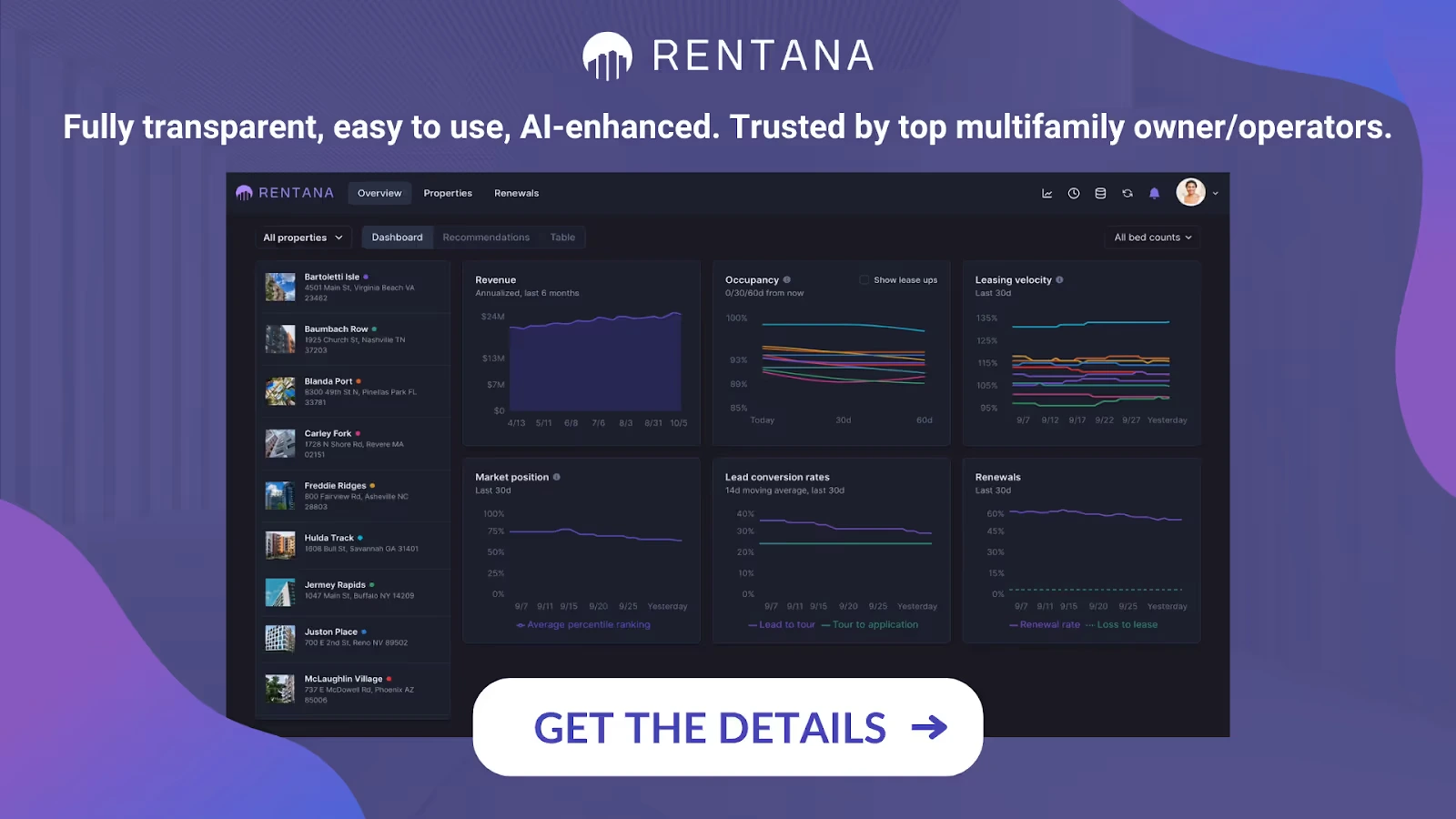
Rentana helps teams evaluate concession decisions within a broader view of asset performance rather than treating specials as a standalone leasing tactic. Leasing velocity, renewal conversion, forward availability, exposure, achieved rents, lease trade-outs, unit-group performance, and leasing-funnel activity provide context for understanding where performance may need support and whether the issue appears temporary, persistent, or unrelated to price.
AI-generated property insights help teams understand what is changing at a property, why it may matter operationally, and which factors may be contributing to the shift. Leasing-funnel analysis adds visibility into where prospect activity may be slowing, helping teams evaluate whether a concession is likely to address the actual issue or whether the challenge may be tied to marketing reach, leasing execution, product positioning, or another stage of the funnel.
Rentana also allows teams to evaluate specials alongside leasing-demand insights and related performance indicators. This helps operators understand whether an offer appears to be improving demand on the intended inventory or whether a different response may be more appropriate.
Custom unit groups and amenity adjustments provide another option when the challenge is tied to a lasting difference in unit value. If a unit or group repeatedly requires a temporary concession because of a persistent feature, teams can evaluate whether a more durable amenity adjustment may create a more sustainable rent position across both the initial lease and future renewals.
Predicted occupancy shows what is anticipated to happen under current conditions by connecting current leasing activity, renewal trends, and future availability. This helps teams evaluate whether a faster occupancy response may be needed or whether a longer target timeframe and more gradual recovery may better support the asset’s occupancy, effective-rent, and revenue objectives.
Rentana’s independent pricing recommendations include transparent explanations of the demand, availability, and performance factors influencing each recommendation. Teams can use that context to compare potential responses, including a pricing change, a special, an amenity adjustment, a revised target timeframe, or no immediate action.
Rentana does not determine whether a concession should be offered or automatically implement one. The operator remains responsible for evaluating the asset strategy, onsite conditions, expected vacancy cost, effective-rent impact, resident experience, and final decision.
Don’t Miss:
- Apartment Rent Pricing: 7 Factors to Evaluate
- The Best Rent Reporting Tools in Real Estate
Conclusion on Apartment Rent Concessions
Apartment concessions are a legitimate operating tool, but they are not the right response to every occupancy or leasing challenge. The strongest concession strategies begin by identifying whether the problem is temporary, persistent, unit-specific, resident-specific, or broader than the property can reasonably solve through incentives.
A temporary demand gap may support a targeted concession. A lasting unit disadvantage may be better addressed through an amenity adjustment. A strong in-place resident may justify a retention-focused offer that protects the rent roll. And a property facing broader exposure may protect more NOI by accepting a longer recovery timeframe instead of discounting a large portion of future leases.
The goal is not simply to improve occupancy as quickly as possible. It is to improve performance without unnecessarily weakening effective rent, renewal positioning, or the long-term rent roll. A concession is most valuable when it changes the outcome on the units or residents that actually need support and when its full cost is lower than the alternatives the property is likely to face.