Managing a large multifamily portfolio has never been simple, but it has never been this complex either. AI for large multifamily portfolios is becoming essential as pricing shifts daily, leasing patterns change by market, renewals impact occupancy months in advance, and decisions made at one property can ripple across an entire portfolio.
For many operators, the challenge is not a lack of information, but the inability to turn it into clear, timely action. Spreadsheets, static reports, and disconnected tools struggle to keep up at scale. This is where AI support for large multifamily portfolios has moved from a “nice to have” to a true competitive advantage in portfolio management and revenue performance.
We will explore what large multifamily portfolios actually need from AI, where AI delivers the most value, and what sets the best AI tools for multifamily portfolio management apart when it comes to managing performance across hundreds or thousands of units.
Related: The Best AI Tools for Real Estate Investors
What Large Multifamily Portfolios Need From AI
As multifamily portfolios grow, managing performance becomes less about individual properties and more about coordination, speed, and consistency across the entire portfolio. What works for a handful of communities often breaks down at scale.
Large portfolios introduce complexity on multiple levels. Each property has its own leasing patterns, renewal cycles, pricing pressure, and market dynamics. Multiply that by dozens or hundreds of assets, and it becomes nearly impossible to track everything accurately using manual processes or static tools.
Speed of decision-making also becomes critical. Pricing, leasing, and renewal decisions often need to be made daily or weekly, not monthly. Traditional reporting tools tend to lag behind real conditions, leaving teams to react after performance has already shifted.
At scale, traditional tools struggle to connect signals across systems. Leasing activity, occupancy trends, pricing changes, and renewals often live in separate platforms, making it difficult to see how one decision impacts another. Teams are left stitching together fragmented views instead of working from a single source of truth.
This is where AI becomes essential. Large multifamily portfolios need AI-driven multifamily software that can continuously process changing conditions, forecast occupancy trends, surface patterns that are easy to miss, and support faster, more confident decisions.
AI is not about replacing human judgment, but about giving teams the visibility and context they need to manage complexity at scale.
Top Pick: AI for Commercial Real Estate: Top 9 Tools
Where AI Adds the Most Value in Multifamily Operations

AI delivers the most value in multifamily when it supports decisions that are frequent, time-sensitive, and difficult to manage at scale. These areas tend to sit at the intersection of revenue, operations, and portfolio oversight.
1. Pricing Decisions at Scale
Pricing is one of the most complex challenges in large portfolios.
Each property faces different demand conditions, competitive pressure, and leasing velocity. AI-powered pricing optimization helps evaluate rent levels across markets, unit types, and properties simultaneously, adjusting recommendations as conditions change.
Instead of relying on static pricing rules or manual reviews, teams can respond more quickly to shifts in demand while maintaining consistency across the portfolio.
2. Occupancy Forecasting and Risk Identification
Future occupancy drives many downstream decisions, from staffing to revenue planning.
AI helps forecast occupancy across multifamily portfolios by connecting past performance, leasing activity, upcoming lease expirations, and seasonal behavior into forward looking occupancy forecasts. This allows teams to see potential risks early, before vacancies appear.
With forward-looking visibility, operators can take action sooner and reduce volatility across the portfolio.
3. Lease Renewal Strategy and Retention
Renewals play a major role in stabilizing occupancy and controlling turnover costs.
AI supports renewal decisions by evaluating market movement, pricing sensitivity, and renewal behavior across similar units and properties. This helps teams make renewal offers that balance resident retention with revenue goals.
At scale, AI-driven renewal strategy creates consistency across large multifamily portfolios that is difficult to achieve manually.
4. Portfolio-Level Visibility and Prioritization
Large portfolios require clear visibility across all assets.
AI-powered portfolio dashboards highlight which properties are on track and which need attention, supporting large-scale multifamily portfolio management decisions. Rather than reacting to issues after they escalate, teams can prioritize resources based on forecasted performance and emerging trends.
This makes it easier for regional managers and leadership to stay aligned.
5. Decision Support for Cross-Functional Teams
In large organizations, decisions are rarely made in isolation.
AI acts as a shared decision-support layer, providing consistent insights across leasing, revenue, and operations teams. When everyone is working from the same signals, alignment improves and execution becomes faster.
AI does not replace human judgment, but it reduces friction and uncertainty in complex decision-making.
Related: 21+ Ways Real Estate Agents Can Use AI Easily
Why Rentana Stands Out for Large Multifamily Portfolios
Large multifamily portfolios need AI that does more than generate pricing recommendations. They need a system that helps teams understand what is happening, why it is happening, and where to focus next. This is where Rentana stands out.
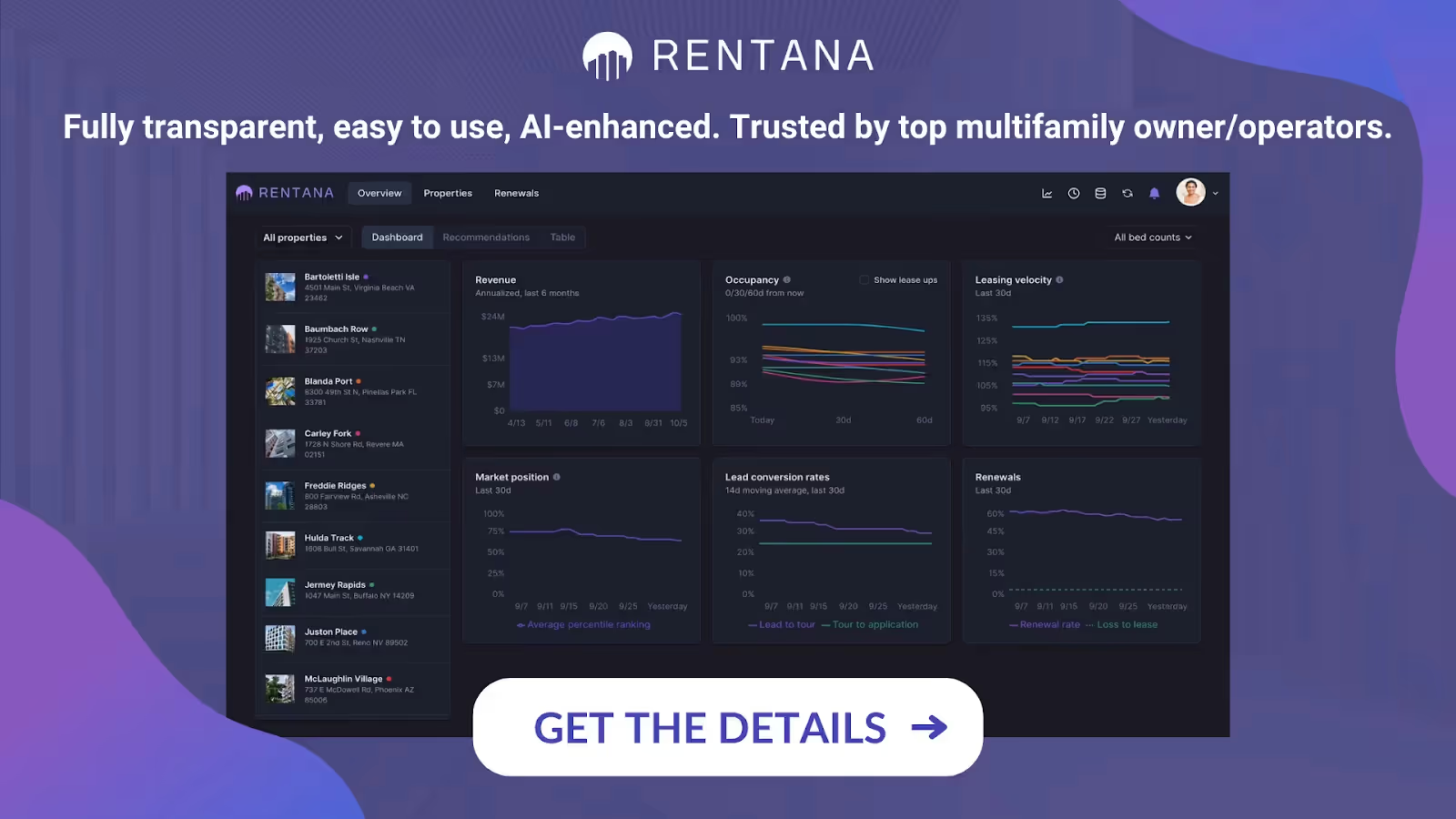
Rentana is built around portfolio-level visibility. Teams can view all portfolios in one place and instantly see performance signals using clear red, yellow, and green indicators and insights in plain language explaining the key factors contributing to performance and actionable next steps.
This allows regional leaders and operators to identify which properties are on track and which require attention, and direct teams on actions to take without digging through reports or switching tools. For large multifamily portfolios, this level of AI-driven prioritization is essential for managing performance at scale.
At the property level, Rentana connects occupancy trends, demand movement, and availability into a single view. Teams can see how occupancy has been trending over time, how demand is changing, and what availability looks like going forward. This makes occupancy forecasting more practical and actionable across large multifamily portfolios, especially when managing dozens or hundreds of assets.
Rentana’s AI-powered pricing recommendations are designed to be transparent rather than opaque. Every recommendation is paired with an explanation that shows the underlying logic and supporting indicators, along with relevant performance graphs.
This allows teams to evaluate, accept, or override recommendations with confidence instead of blindly trusting a black box.
Another area where Rentana differentiates itself is flexibility. Teams can analyze performance by portfolio, property, unit type, or bedroom type, and compare trends across markets or asset groups.
The metrics browser allows users to explore specific questions without needing custom reports, which is especially valuable in large organizations where needs vary by role.
Finally, Rentana is built to work within existing workflows. Pricing updates can be written back directly to the property management system, and data can be accessed through downloads or APIs for use in other tools. This reduces friction and keeps teams aligned across leasing, revenue, and operations.
Rather than positioning AI as a replacement for human judgment, Rentana supports better decision-making by giving large multifamily teams clearer visibility, stronger context, and faster feedback across the portfolio.
Read Also: The Best AI Property Insights Platforms
Proven at Scale: How Large Multifamily Portfolios Use Rentana
Rentana’s value becomes clearest when it is deployed at scale. Across large, complex multifamily portfolios, teams have used Rentana to improve occupancy, accelerate decision-making, and drive measurable financial results without disrupting existing workflows. These real-world examples highlight how AI for multifamily portfolio management can deliver measurable performance gains at scale.
URS Capital Partners: Fast Deployment, Measurable Impact
For URS Capital Partners, Rentana marked its first move into revenue management technology. In just two weeks, the firm deployed Rentana across 12 properties totaling 2,500 units, a pace that allowed teams to start acting on insights almost immediately.
Over the following year, URS saw a 414 percent return on investment, driven by meaningful improvements in both occupancy and operating performance. The portfolio achieved 8.2 percent sequential NOI growth from Q1 to Q2 and a 7.3 percent daily occupancy improvement between March and September 2025.
Operational efficiency improved as well. Rent reviews that previously took 90 minutes per property were reduced to just 15 minutes, allowing teams to complete pricing analysis five times faster and save more than four hours each week.
After evaluating multiple alternatives, URS selected Rentana for its speed, intuitive design, and hands-on support. According to Heather Moore, Consultant at URS Capital Partners, Rentana went beyond traditional reporting.
“Rentana is the best tool to manage your business and focus on what matters. It’s beyond BI. It’s an interactive dashboard where operators and asset managers can see not just if they can make more money, but exactly how to make more money.”
By combining market trends with portfolio-specific information and presenting recommendations with clear rationale, Rentana helped URS anticipate lease turnover, identify revenue opportunities, and improve occupancy without slowing teams down or forcing process changes.
29th Street Capital: Head-to-Head Results Across 12,000+ Units
29th Street Capital selected Rentana after a rigorous evaluation process designed for scale. The firm reviewed eight vendors, narrowed the field to two finalists, and then ran a 90-day head-to-head pilot against an industry veteran’s new platform to support its 12,000-plus unit portfolio.
The results were decisive. Rentana-powered properties delivered $4.6 million in incremental property value and 3.5 percent stronger net rental income growth compared to the control group. While competitor-managed assets experienced slower growth and rising vacancies, Rentana-supported communities maintained stronger occupancy and rent performance.
Operational performance also set Rentana apart. New properties were onboarded in one to two days, compared to three to six weeks with legacy systems. Support response times averaged five minutes, and the platform shipped 125 new features during the pilot period, including custom tools requested by 29SC teams.
Robert Waz, VP at 29th Street Capital, highlighted the difference:
“I would recommend Rentana without a doubt. The UI is miles ahead, we trust their data security, and their fast, insightful and personalized platform gives us a strategic advantage to grow our assets.”
For 29SC, Rentana’s transparent pricing logic, portfolio-wide visibility, and responsive onboarding made it easier for teams at every level to make faster, more confident decisions.
Built for Large Portfolios, Proven in Practice
Across both portfolios, Rentana succeeded where legacy systems often struggle: rapid adoption, clear visibility, and consistent results at scale. By supporting pricing, occupancy, and renewal decisions within a single, intuitive platform, Rentana helped large multifamily teams move faster, stay aligned, and improve performance without relying on black-box models or fragmented tools.
Together, these outcomes reinforce Rentana’s position as an AI platform designed not just to analyze large multifamily portfolios, but to actively support better decisions across them.
Don’t Miss: How to Choose a PropTech Software: A Guide for investors
Conclusion
Managing large multifamily portfolios has reached a point where scale alone creates complexity. As pricing shifts faster, occupancy risks emerge earlier, and decisions ripple across dozens of properties at once, the tools that once worked for smaller portfolios start to fall short.
AI support is no longer about automation for its own sake. It is about giving teams the visibility, speed, and context needed to make better decisions across pricing, leasing, renewals, and portfolio performance.
AI for large multifamily portfolios helps operators forecast occupancy, optimize pricing, and manage performance ascross assets withg greater confidence. Platforms like Rentana show what is possible when AI is built specifically for large multifamily portfolios, not as a black box, but as a decision-support layer teams can trust. The real advantage comes from turning complexity into clarity and using that clarity to stay ahead as portfolios continue to grow.