Real estate decisions rarely fail because of a lack of data.
They fail because the signal is buried.
Across portfolios, operators are constantly evaluating pricing, leasing activity, availability, and market conditions. The information exists, but it is scattered across dashboards, reports, and systems that do not always connect. By the time signals are manually connected, the opportunity to act has often already narrowed.
This is where AI real estate assistants are starting to play a different role.
An AI real estate assistant is not just a tool that automates tasks or answers questions. It acts as a layer on top of existing data, helping operators interpret what is happening across properties and portfolios in real time. Instead of searching for insights, teams are presented with them.
The shift is subtle but important.
Rather than asking “What does the data say?” operators begin asking “What does this mean for our next decision?”
AI real estate assistants surface changes in leasing trends, highlight pricing signals, flag potential exposure risks, and connect those signals into a clearer picture of performance. They reduce the time between signal and decision, which is where most operational advantage is created.
In fact, Morgan Stanley estimates that AI could deliver roughly $34 billion in efficiency gains to the real estate industry over the next five years.
As real estate operations become more data-driven, the role of AI is not to replace decision-making.
It is to make it easier to see what matters, sooner.
Related:
- How AI Agents Are Changing Real Estate Research
- Why Investors Are Using AI-Assisted Real Estate Advice
What Is an AI Assistant for Real Estate?
An AI real estate assistant is a tool that helps operators interpret data, surface insights, and support decision-making across properties and portfolios.
Unlike traditional software that requires users to search for information, an AI assistant brings relevant signals forward. It analyzes operational data such as leasing activity, pricing trends, availability, and market conditions, then highlights what may require attention.
The goal is not to replace human judgment.
The goal is to make it easier to understand what is happening and what actions may be needed next.
In practice, an AI real estate assistant sits on top of existing systems and workflows. It connects data from different sources, identifies patterns, and provides context that would otherwise take time to uncover. Instead of reviewing multiple reports, operators can quickly see where performance is changing and why.
For example, an AI real estate assistant may:
- Highlight when leasing momentum is slowing at a property that is misaligned with seasonal demand or market conditions
- Surface pricing signals that may need adjustment to meet asset performance targets
- Identify upcoming availability based on renewal and lease data
- Detect patterns in demand across unit types or locations
This shifts the role of analytics.
Rather than manually interpreting data, operators can focus on evaluating insights and making decisions. Importantly, AI real estate assistants do not directly control operational outcomes such as leasing conversion. They help operators understand the drivers behind performance, including whether issues stem from pricing alignment, demand levels, or conversion friction within the leasing funnel.
As real estate operations become more complex, this ability to interpret data efficiently is becoming a key part of how portfolios are managed.
Read Also:
9 Ways AI Real Estate Assistants Help Multifamily Operators

- Surface leasing trends early
- Interpret pricing signals in real time
- Connect renewal activity to future availability
- Identify lease expiration exposure risks
- Analyze floorplan-level demand patterns
- Provide context behind pricing recommendations
- Highlight changes in portfolio performance
- Forecast predicted occupancy and availability
- Guide operators toward the next best action
1. Surface Leasing Trends Early
Leasing trends rarely change all at once. In most cases, small shifts begin to appear before they show up in occupancy or revenue. A slight slowdown in leasing velocity, fewer applications for a specific unit type, or longer days on market can all signal that demand conditions are changing.
The challenge for operators is catching these signals early enough to respond.
In many portfolios, leasing data is reviewed after the fact through weekly or monthly reports. By the time a trend becomes obvious, the underlying issue may have already affected availability and pricing performance.
AI real estate assistants help close this gap by continuously monitoring leasing activity and surfacing early indicators of change. These signals often appear as changes in velocity, demand patterns, or conversion efficiency across the funnel, giving operators a clearer view of where performance is beginning to diverge.
With Rentana, these signals are visible directly within the platform. Leasing velocity is tracked across properties and unit types, and emerging slowdowns are surfaced through portfolio-level insights. Asset managers can move from a high-level view into individual properties to understand what is driving the change.
This kind of visibility allows operators to respond earlier, before shifts in leasing activity begin to affect the rest of the portfolio.
2. Interpret Pricing Signals in Real Time
Pricing signals are constantly changing, but they are not always easy to interpret.
A unit may be receiving strong interest but not converting. A floorplan may be leasing quickly while another lags behind. Concessions may increase at one property but not others. Individually, these signals are incomplete. Together, they indicate whether pricing is aligned with demand. AI real estate assistants help connect these signals.
By analyzing leasing activity, availability, and public market conditions together, they provide context around how pricing is performing. Instead of relying on periodic comp checks, operators can evaluate whether pricing aligns with current demand as it evolves.
Rentana’s pricing recommendations are paired with AI-generated explanations that show the drivers influencing each suggestion. These explanations often surface whether demand is strong but constrained by pricing, or whether demand itself is insufficient, helping operators distinguish between pricing adjustments and non-pricing issues.
Read Also:
3. Connect Renewal Activity to Future Availability
Renewal activity is one of the most important drivers of future availability, yet it is often evaluated separately from pricing and leasing strategy.
When renewal conversions are strong, fewer units return to the market. When they decline, availability increases, creating future leasing pressure. The challenge is understanding how renewal behavior today will affect availability later.
AI real estate assistants connect these signals by analyzing renewal trends alongside leasing activity and predicted availability. Instead of viewing renewals as a separate workflow, operators can see how retention patterns influence future supply across the portfolio.
Renewal activity on Rentana feeds directly to predicted occupancy and availability insights. This allows operators to evaluate how retention decisions are shaping future supply and whether current renewal strategy supports or increases future exposure risk.
By connecting renewal activity to future availability, operators gain a clearer view of what is coming next and can plan ahead rather than react after units return to the market.
Related:
- Lease Renewal Agreement: How to Manage The Entire Process Easily
- How Lease Rent Optimizers Help You Set The Right Rental Price
4. Identify Lease Expiration Exposure Risks
Lease expiration patterns can shape performance months in advance.
When too many leases are scheduled to end within the same period, availability can increase quickly, creating leasing pressure. These exposure clusters often develop gradually and may not be visible until they begin to impact occupancy.
AI real estate assistants help identify these patterns early by analyzing lease schedules and highlighting where exposure may be building. With Rentana, exposure is visualized across months and properties, making it easier to identify clusters before they become operational challenges. This allows operators to connect current leasing and renewal decisions to future exposure, rather than reacting once availability increases.
5. Analyze Floorplan-Level Demand Patterns
Demand does not move evenly across all layouts.
Within the same property, one floorplan may lease quickly while another lags behind. Across a portfolio, these patterns often repeat.
AI real estate assistants help operators analyze demand at a granular level by evaluating leasing performance across floorplans. Rentana enables this through floorplan and unit-level performance insights across properties. In addition to demand signals, these insights can reveal where strong interest is not converting, helping operators determine whether pricing, positioning, or leasing execution is creating friction.
6. Provide Context Behind Pricing Recommendations
A pricing recommendation on its own is incomplete.
Without context, operators cannot determine whether a suggested change reflects demand, temporary conditions, broader trends, or data entry error.
AI assistants provide that context by explaining the drivers behind each recommendation.
With Rentana, pricing recommendations are paired with AI-generated explanations that highlight the key drivers influencing performance. These drivers typically include leasing velocity, demand strength, conversion signals, and availability trends, allowing operators to evaluate whether pricing adjustments are the appropriate lever.
This improves decision-making by making recommendations interpretable rather than opaque.
7. Highlight Changes in Portfolio Performance
Performance rarely shifts uniformly across a portfolio.
Some properties may show, while others strengthen or experience different demand patterns.
AI real estate assistants help surface these changes by continuously monitoring performance across assets.
Rentana’s portfolio dashboards highlight where assets are diverging from expectations, allowing asset managers to quickly identify where attention is needed. These changes often appear in first leading indicators such as leasing velocity, demand patterns, or predicted occupancy rather than lagging metrics like revenue or physical occupancy.
By surfacing these signals early, AI assistants help teams understand not just that performance is changing, but how it is changing and action items to take.
Rather than reviewing every property equally, teams can focus on assets where performance signals are changing.
This allows asset managers to prioritize decisions across the portfolio more effectively, allocating time, pricing adjustments, and leasing strategy to the assets that will have the greatest impact on overall performance.
Top Picks:
- Agentic AI in Multifamily: Use cases & How it Works
- Conversational AI in Real Estate: A Complete Guide
8. Forecast Predicted Occupancy and Availability
Leasing decisions are often made based on what is available today, but performance is shaped by what will be available next.
Future availability is influenced by current leases, renewal behavior, and leasing activity. These factors do not operate independently. They compound over time and determine how much supply will enter the market in future periods. Without a clear view of how these factors come together, operators are often reacting to availability after it appears rather than planning for it in advance.
AI real estate assistants help shift this perspective forward.
By analyzing lease data, renewal trends, and current leasing activity, they provide a view of how occupancy and availability are likely to develop over time. This forward-looking visibility allows operators to identify when future supply may exceed demand and where leasing pressure is likely to emerge.
With Rentana, predicted occupancy modeling and availability insights give asset managers visibility into how supply is expected to evolve across properties. Teams can see when availability may increase, how exposure is building, and how leasing momentum is likely to interact with future supply. These insights also help operators evaluate whether current pricing and leasing activity are aligned with future considerations, rather than just current occupancy levels.
This forward-looking view makes it easier to guide leasing activity and maintain more stable performance across the portfolio.
Related to Occupancy:
- How to Forecast Occupancy in Multifamily Real Estate
- How to Calculate Occupancy Rate (Formula and Examples)
9. Guide Operators Toward the Next Best Action
Data on its own does not improve performance. What matters is how quickly it leads to a decision.
In most portfolios, the gap is not visibility. It is knowing what to do next. Multiple signals may point to a change in leasing activity, pricing performance, or future availability, but without clear prioritization, teams are left to interpret and sequence decisions on their own.
AI assistants help close this gap by connecting signals to actions.
Instead of presenting data in isolation, they highlight what requires attention and suggest where operators should focus. A slowdown in leasing velocity, a shift in floorplan demand, or an increase in upcoming availability can be surfaced alongside the context needed to evaluate next steps.
Importantly, not all signals that require the same response. Some may indicate pricing misalignment, while others reflect demand constraints or operation friction within the leasing funnel. AI real estate assistants help distinguish between these scenarios so operators can apply the appropriate lever.
Rentana pairs insights with recommended actions, helping operators move from analysis to execution more efficiently. Asset managers can see where pricing may need adjustment, where exposure is building, or where leasing momentum is changing, all within the same workflow.
These recommendations are grounded in the underlying drivers of performance, allowing operators to take action with a clear understanding of why a change is needed. This reduces the time between identifying a signal and responding to it.
As a result, decision making becomes more consistent across the portfolio, with teams focusing on the highest-impact actions rather than reacting to individual data points in isolation.
How Rentana Works as an AI Real Estate Assistant for Multifamily Teams
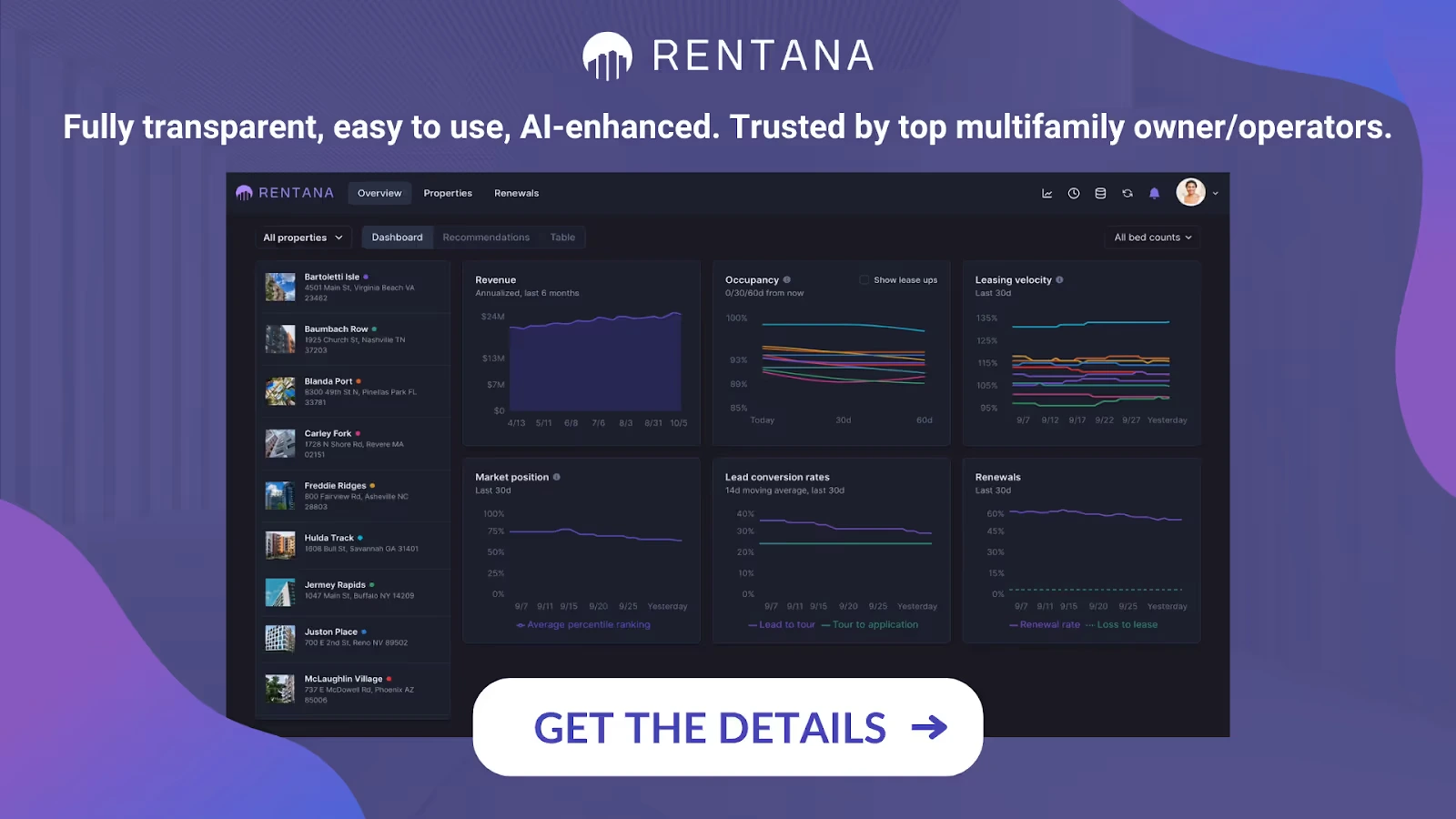
- AI that interprets data, not just automates tasks: Rentana surfaces the underlying drivers across leasing, pricing, renewals, and exposure, helping operators understand not just what is happening, but why performance is changing.
- Pricing recommendations with clear explanation: Every recommendation is supported by AI-generated insights that connect leasing activity, demand signals, and availability conditions, providing full transparency into the reasoning behind each decision.
- Leasing velocity and demand signal analysis: Tracks how quickly units are leasing and highlights changes in momentum across properties and floorplans, including signals that indicate whether demand is strengthening, weakening, or failing to convert.
- Predicted occupancy and availability forecasting: Provides forward-looking visibility into how availability and occupancy are likely to develop, allowing operators to align marketing, pricing, and leasing strategies with future conditions rather than current snapshots.
- Expiration exposure visualization: Helps identify lease clustering and manage exposure risk across the portfolio, with visibility into how current leasing and renewal decisions are shaping future availability patterns.
- Floorplan-level performance insights: Analyzes demand patterns across unit types to guide pricing and leasing strategy, including where strong interest may not be translating into leases due to pricing or conversion friction.
- Portfolio-wide dashboards and performance tracking: Allows asset managers to monitor performance across properties and prioritize decisions, focusing attention on assets where leading indicators are beginning to shift.
- Guided insights with recommended actions: Connects signals to next steps so teams can move from analysis to execution quickly, with recommendations grounded in the key drivers impacting performance.
- Built as a revenue intelligence platform, not a point solution: Brings together pricing, leasing, renewals, and analytics into a single system that supports portfolio-wide decision making, enabling operators to interpret signals and apply strategy within one continuous workflow.
Conclusion: AI Real Estate Assistants Bring Clarity
What would change if your team did not have to search for insights, but instead had them surfaced in real time?
That is the role AI real estate assistants are beginning to play in real estate.
As portfolios grow and operations become more data-driven, the challenge is no longer access to information. It is the ability to interpret signals quickly enough to act. Leasing trends, pricing performance, renewal behavior, and availability patterns are all connected, but without the right tools, those connections are difficult to see.
AI real estate assistants help bring that clarity.
They do not replace decision-making. They support it by highlighting what is changing, explaining why it matters, and helping operators focus on what to do next.
Platforms like Rentana extend this further by combining AI-driven insights with pricing, leasing analytics, and portfolio visibility. Instead of working across separate tools, operators can evaluate performance, understand signals, and apply decisions within a single workflow. This allows operators to identify the true drivers of performance and apply the right lever, rather than treating all leasing challenges as the same problem.
Frequently Asked Questions on Real Estate AI Assistants
What Form Of AI Is Most Commonly Used In Real Estate?
The most commonly used AI in real estate includes predictive analytics, machine learning, and generative AI. These technologies help with property valuation, lead generation, pricing optimization, and automated communication with clients.
Is ChatGPT The Best AI Assistant Right Now?
ChatGPT is one of the most widely used AI assistants due to its ability to generate content, answer questions, and automate communication. However, the best AI assistant depends on the use case, with some tools specializing in real estate workflows, lead management, or pricing analysis.
How Many Realtors Use AI?
A growing number of realtors are using AI, with industry surveys showing that a significant portion of agents now rely on AI tools for marketing, lead generation, and client communication. Adoption continues to increase as AI becomes more accessible and valuable in real estate workflows.