How many spreadsheets does it take to understand a real estate portfolio today?
For many investors and operators, the answer is still “too many.” Market reports, leasing dashboards, expense summaries, occupancy updates, and renewal tracking often live in different systems. By the time all of that information is compiled and reviewed, the market may have already shifted.
Real estate has always been a data-driven business. But the volume of information operators must interpret to manage portfolio performance has expanded dramatically in recent years.
Public supply pipelines, shifting demand patterns, insurance and tax pressures, leasing velocity, and renewal timing all influence how a property performs. Understanding how these signals interact is not always straightforward.
This growing complexity is one reason many operators and asset managers are beginning to explore AI-assisted real estate advice.
When applied thoughtfully, AI can help organize large amounts of operational and public market data, surface patterns across portfolios, and provide clearer context around performance trends. The goal is not to replace investor judgment. It is to support it with structured insight that would otherwise take significant time to assemble manually.
As real estate portfolios become larger and markets evolve more quickly, the ability to interpret information efficiently is becoming increasingly valuable. Below are several reasons why more investors & operators are beginning to turn to AI-assisted real estate advice.
Related: The Best AI Tools for Real Estate Investors
AI-Assisted Real Estate Advice: 5 Reasons Investors Shouldn't Miss Out on It

1. Real Estate Data Has Become Too Complex to Interpret Manually
Real estate has always relied on data. What has changed is the sheer volume of information operators and asset managers must interpret to evaluate property performance.
Not long ago, understanding a property’s revenue and occupancy performance might have involved reviewing a handful of reports. Today, teams often evaluate a much broader set of signals. Market research and public data sources track rent trends, supply deliveries, and broader demand conditions.
Leasing dashboards measure occupancy, conversion, and days vacant. Operating statements reflect rising insurance costs, tax reassessments, and payroll changes. Public market data provides insight into new construction pipelines and shifting demand patterns.
Each of these inputs offers useful information. The challenge is that they rarely exist in one place.
An asset manager might review a market report showing new deliveries entering a submarket while also examining leasing velocity at their own property.
At the same time, they may be tracking operating expenses that have increased due to insurance adjustments or property tax reassessments. Understanding how these signals interact requires connecting data across multiple sources.
Consider a simple example. A property’s occupancy may decline from 95 percent to 92 percent over the course of a quarter.
Without additional context, that shift could suggest a leasing problem. But when viewed alongside leasing activity and renewal timelines, the explanation may look different. Lead volume may remain strong while a large group of leases expired during the same period. At the same time, new leases may be signing higher rents, indicating demand remains healthy even as turnover temporarily increases.
By connecting leasing funnel activity, renewal exposure, and revenue performance, operators can determine whether performance changes reflect operational issues or normal portfolio dynamics.Interpreting these relationships manually takes time and careful analysis.
As portfolios grow and markets evolve more quickly, the number of variables operators must monitor to maintain performance continues to increase.
This is where ai-assisted real estate advice can be useful. Rather than replacing industry expertise, AI can help organize large volumes of operational and public market data into a clearer structure. By surfacing patterns and highlighting connections between different signals, it allows teams to spend less time gathering information and more time evaluating what the information means.
Related: How To Do A Rental Market Analysis Like a Pro (With AI Tools)
2. Operators Need Faster Insight in a Changing Market
Real estate decisions have always required patience. Properties are long-term assets, and investors are accustomed to evaluating performance over months and years rather than days.
What has changed is the speed at which market signals move.
Supply deliveries can shift the dynamics of a submarket within a single quarter. When large waves of new units enter a market, rents and vacancy rates can adjust quickly as the market absorbs that inventory. Industry research shows that experiencing elevated new supply often sees temporary pressure on rent growth and occupancy before demand stabilizes.
Interest rate changes can alter financing assumptions almost overnight. Insurance premiums and property taxes can reset operating costs faster than expected.
At the same time, leasing performance at the property level can fluctuate week by week as demand patterns evolve.
Traditional reporting cycles often struggle to keep up with this pace.
Many teams still rely on monthly or quarterly updates to understand how their assets are performing. By the time those reports are compiled, reviewed, and distributed, the underlying conditions may already be different.
A leasing slowdown might have started weeks earlier. A cluster of expirations may already be affecting availability. Pricing decisions may have been made without full visibility into recent leasing activity.
Consider a common scenario. An asset manager reviews the latest monthly report and notices that occupancy has slipped slightly across several properties. The numbers alone do not explain why. Has leasing traffic slowed? Are units taking longer to convert from application to lease? Did a group of renewals decline during the same period?
Answering those questions often requires pulling data from several systems and interpreting it manually.
AI-assisted analysis helps shorten that process. Instead of waiting for the next reporting cycle, AI systems can continuously organize operational signals such as leasing activity, renewal timelines, pricing performance, and availability trends.
This allows operators to identify shifts earlier and understand how those changes may influence both occupancy and near-term revenue performance.
The goal is not to react to every short-term fluctuation. Real estate still rewards long-term thinking. But having faster insight into changing conditions allows operators and asset managers to adjust pricing strategy, renewal outreach, and leasing operations with better timing rather than discovering trends after they have already affected portfolio performance.
3. AI Helps Connect Portfolio Performance Signals
One of the most persistent challenges in real estate analysis is understanding what signals are actually driving changes in property performance.
Operators typically have strong visibility into what is happening inside their properties. They can see occupancy trends, leasing velocity, renewal activity, and operating expenses. But interpreting those signals often requires additional context, particularly when pricing, demand, and competitive positioning are changing at the same time.
For example, a property may show rising occupancy alongside strong lead generation. At the same time, competitors in the submarket may begin increasing concessions or adjusting pricing to stimulate demand. Without connecting these signals, it can be difficult to determine whether performance changes reflect strong internal operations, shifting demand patterns, or new competitive pressure.
For example, an operator reviewing leasing performance may see strong occupancy gains and steady leasing velocity at a property. But a closer look may reveal different patterns across floorplans. One unit type may struggle with application conversion or projected occupancy. At the same time, competitive communities begin offering concessions or lowering effective rents. Viewed together, those signals provide important context.
By identifying these differences at the floorplan level, operators can adjust pricing, marketing focus, or leasing strategy with greater precision.
AI-assisted real estate advice surface these patterns automatically, allowing operators to see not only how a property is performing overall, but which specific unit types are driving or limiting performance. hThis approach makes it easier to understand how occupancy trends, leasing momentum, pricing strategy, and competitive activity interact.
Rather than simply asking whether performance has changed, operators can begin to understand the data behind those changes, and determine whether any operational adjustments may be warranted.
Top Pick:
- Multifamily AI Leasing Assistants: Use Cases & Benefits
- How to Forecast Occupancy in Multifamily Real Estate
4. Operators Want Greater Visibility Across Growing Portfolios
Real estate portfolios have become larger and more geographically diverse over the past decade.
Many operators and asset managers now operate across multiple cities, property types, and operating partners. A single portfolio might include stabilized assets in one market, newer developments in another, and properties undergoing repositioning in a third. Each location comes with its own leasing patterns, demand conditions, and operating pressures.
Managing that complexity requires visibility that goes beyond individual property reports.
Looking at assets one by one makes it difficult to recognize broader patterns. An asset manager reviewing a monthly report for each property might notice small changes in occupancy or leasing velocity, but those shifts are harder to interpret without seeing how they relate to the rest of the portfolio.
Consider a situation where several properties across different markets begin to experience slightly longer days vacant between leases. Viewed individually, each property might appear to have only a minor change. But when the trend is visible across the portfolio, it could signal a broader shift in leasing demand, operational execution, or seasonal patterns.
The same applies to renewal timing. A cluster of lease expirations across several assets in the same quarter may not be obvious when reviewing property-level reports separately. But when those timelines are viewed together, operators can identify potential occupancy exposure earlier and begin planning renewal strategy, leasing activity, or marketing efforts in advance.
AI-assisted analysis helps surface these portfolio-level patterns more easily. Instead of manually reviewing dozens of reports, operators can view leasing activity, renewal timelines, availability signals, and performance trends across multiple properties in a single structured view.
This type of visibility makes it easier to identify where attention may be needed and where performance is holding steady.
Instead of relying on fragmented reports, operators can evaluate portfolio health through a structured, data-driven view that highlights emerging trends, potential risks, and actionable responses earlier. For operators managing larger or multi-market portfolios, that clarity becomes increasingly valuable.
Related:
5. AI Supports Decision-Making Without Replacing Investor Judgment
Despite the growing interest in AI, most teams are not looking for technology that makes decisions for them. What they want is better context.
Real estate operations still rely heavily on experience, local knowledge, and long-term perspective. A seasoned asset manager understands that no dataset can fully capture the nuances of a neighborhood, the reputation of an operator, or the strategic value of a particular asset. Those types of insights still come from human judgment.
What AI can do is support that judgment by organizing information more effectively.
Instead of reviewing dozens of separate reports, operators can use AI-assisted systems to surface patterns that might otherwise take hours to identify or be missed entirely.
For example, an investor might want to understand whether renewal activity is trending up or down across several properties, or whether leasing velocity has slowed in a particular submarket. AI can analyze operational data across portfolios and markets to highlight these patterns quickly and consistently.
The most effective systems also make these insights transparent, providing recommended actions to consider while clearly showing the underlying logic behind those recommendations.
This does not eliminate the need for human interpretation. In fact, it often makes that interpretation more important. Once patterns are visible, operators can apply their own experience to determine what those signals reflect operational execution, demand shifts, or normal portfolio cycles.
Think of AI as an analytical layer rather than an automated decision-maker. It helps organize complexity, identify relationships between data points, and surface insights that might otherwise remain buried in reports.
For investors and operators, this combination of structured analysis and human expertise creates a more informed approach to decision-making. AI provides the clarity, while judgment provides the direction.
How Platforms Like Rentana Support AI-Assisted Real Estate Advice
The growing interest in AI-assisted real estate advice is not happening in theory. It is increasingly supported by technology platforms designed to help operators and asset managers interpret complex operational signals and manage portfolios with greater clarity.
Platforms like Rentana are built to address many of the challenges operators face today.
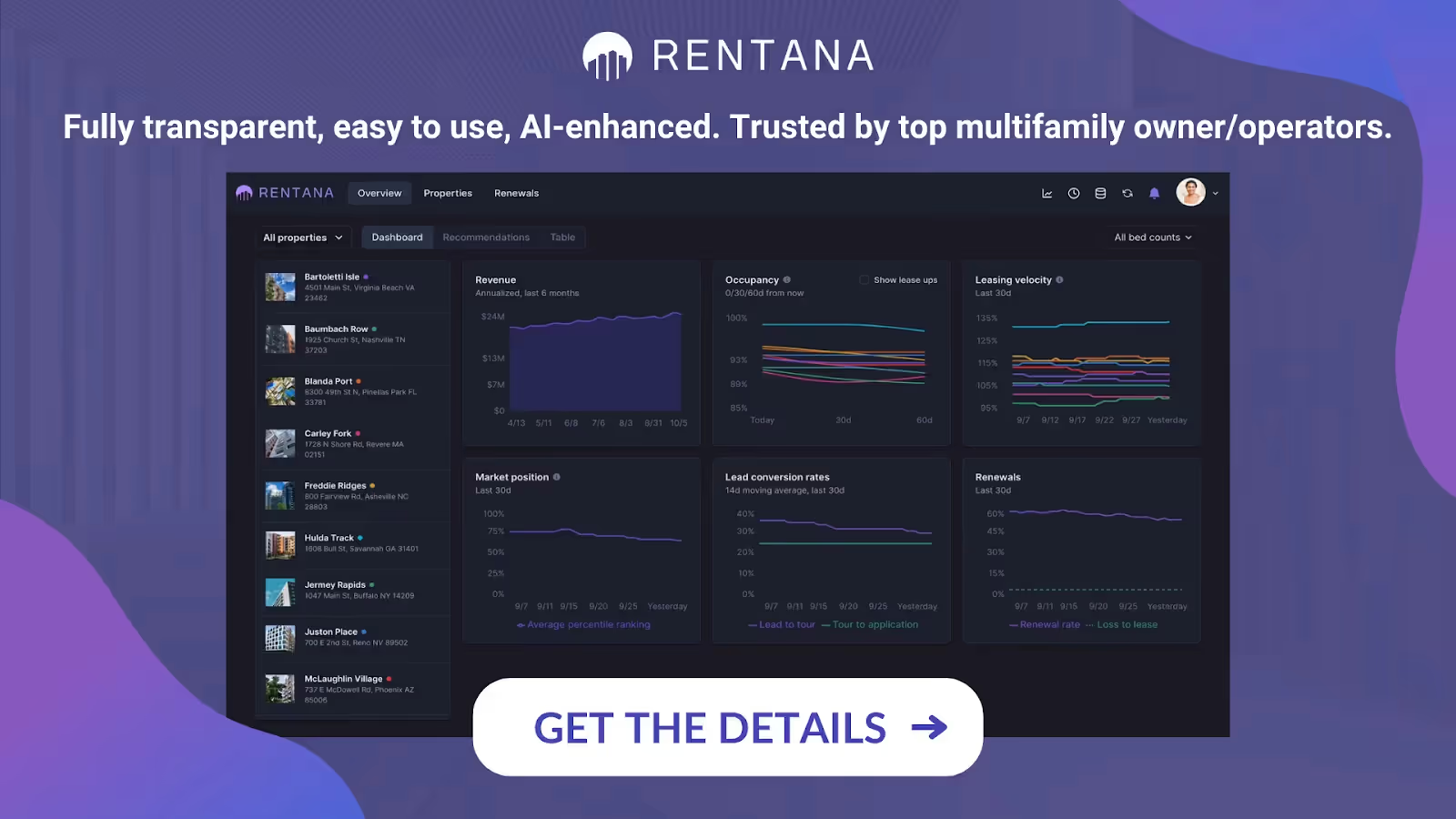
First, Rentana helps organize large volumes of real estate data. Operational metrics such as occupancy, leasing velocity, lease trade out, revenue performance, and future exposure are structured into clear dashboards that allow teams to evaluate portfolio performance and revenue opportunities across properties more efficiently.
Second, Rentana allows teams to analyze portfolio performance more quickly. Instead of compiling reports across multiple systems, asset managers and operators can view portfolio health through structured dashboards and drill down from portfolio level trends into individual properties, floorplans, and even unit-level performance.
Third, Rentana helps connect operational performance signals. Leasing activity, renewal exposure, pricing trends, and competitive positioning can be viewed together, allowing teams to better understand what factors are influencing performance across their assets.
The platform also improves portfolio visibility. Operators managing multiple properties can identify patterns across assets, track renewal activity, and evaluate leasing performance across markets without manually reviewing dozens of reports.
Most importantly, Rentana is designed to support data-driven decision making rather than replace operator judgement. The platform surfaces clear insights, highlights emerging patterns, and provides recommended actions for teams to consider.
These recommendations are presented transparently alongside the underlying data and reasoning, allowing operators to evaluating the logic behind the insight before deciding how to respond. In this way, AI-driven platforms act as an intelligence layer that helps teams interpret portfolio information more clearly, evaluate opportunities and risks earlier, and make decisions with greater confidence.
AI-assisted real estate advice becomes most valuable when it helps operators translate complex data into clearer revenue decisions. The following examples illustrate how institutional operators are applying these insights in practice.
Related:
- How to Use AI for Multifamily Investing & Reporting
- How AI is Changing Real Estate in the USA
Customer Success Stories: How Investors Are Using Rentana for AI-Assisted Real Estate Advice
The value of AI-assisted real estate advice becomes clearer when looking at how real estate investment firms are applying it in practice.
Several institutional operators have adopted Rentana to improve portfolio visibility, leasing performance, and revenue optimization across their assets.
URS Capital Partners
Real estate investment firm URS Capital Partners deployed Rentana across 12 properties totaling 2,500 units in just two weeks as part of its first implementation of revenue management technology.
Over the following year, the firm reported strong performance improvements across its portfolio, including:
- 414 percent return on investment
- 8.2 percent sequential NOI growth from Q1 to Q2
- 7.3 percent improvement in daily occupancy from March to September 2025
- 5x faster rent reviews, reducing pricing analysis time from 90 minutes to 15 minutes per property
The platform allowed URS teams to spend less time manually reviewing pricing data and more time focusing on leasing strategy, pricing decisions, and portfolio performance.
As Heather Moore, Consultant at URS Capital Partners, explained:
“Rentana is the best tool to manage your business and focus on what matters. It’s beyond BI. It’s an interactive dashboard where operators and asset managers can see not just if they can make more money, but exactly how to make more money.”
29th Street Capital
Institutional real estate firm 29th Street Capital (29SC) selected Rentana after conducting a 90-day pilot against another industry platform while evaluating revenue management solutions for its 12,000-unit portfolio.
The results of the trial were significant.
Properties managed with Rentana generated:
- $4.6 million in incremental property value
- 3.5 percent stronger net rental income performance
- Faster decision-making across leasing and pricing operations
Operational efficiency improved as well.
The firm reported:
- 21x faster onboarding for new properties
- 36x faster support response times
- Rapid product improvements, with more than 125 new features released in 90 days
According to Robert Waz, Vice President at 29th Street Capital:
“I would recommend Rentana without a doubt. The UI is miles ahead, we trust their data security, and their fast, insightful and personalized platform gives us a strategic advantage to grow our assets.”
These examples highlight how AI-assisted platforms are already being used by real estate investors to interpret portfolio performance more effectively, respond to changing market conditions, and operate with greater visibility across their assets.
Don’t Miss:
- The Best Multifamily Software for Investors & Property Managers
Conclusion on AI-Assisted Real Estate Advice
AI-assisted real estate advice is gaining traction for a simple reason. Investors and operators are navigating more data, more performance signals, and faster-changing operating.
From interpreting leasing trends and operating expenses to understanding supply pipelines and demand shifts, the challenge is no longer access to data. It is turning that information into clear, actionable insight.
AI can help organize that complexity, surface patterns across portfolios, and provide data-driven context around performance and revenue opportunities. But the role of AI is not to replace operator judgment. Real estate decisions still depend on experience, local knowledge, and long-term strategy.
What AI offers is a more structured way to interpret the signals that shape those decisions.
As technology continues to evolve, the operators who benefit most will be those who treat AI not as a shortcut, but as an analytical layer that helps transform complex portfolio data into clearer insight, stronger revenue decisions, and more confident portfolio management.